Withania somnifera (L.) Dunal
Eng.: Poison gooseberry, or winter cherry. Ara.: Habb el lahw, lahw, bellahw, abeb, abed, semm el far, semm fraakh, ferkaï, sekran, bu rlani, saharaui, zafua, sukun lama, urq ech chefa; the fruit: mordjan, morgaan. Tamahaq: Terrumt, faraorao, faghaoghao, têghida n’ûggûr, shighidad n-aeggur.
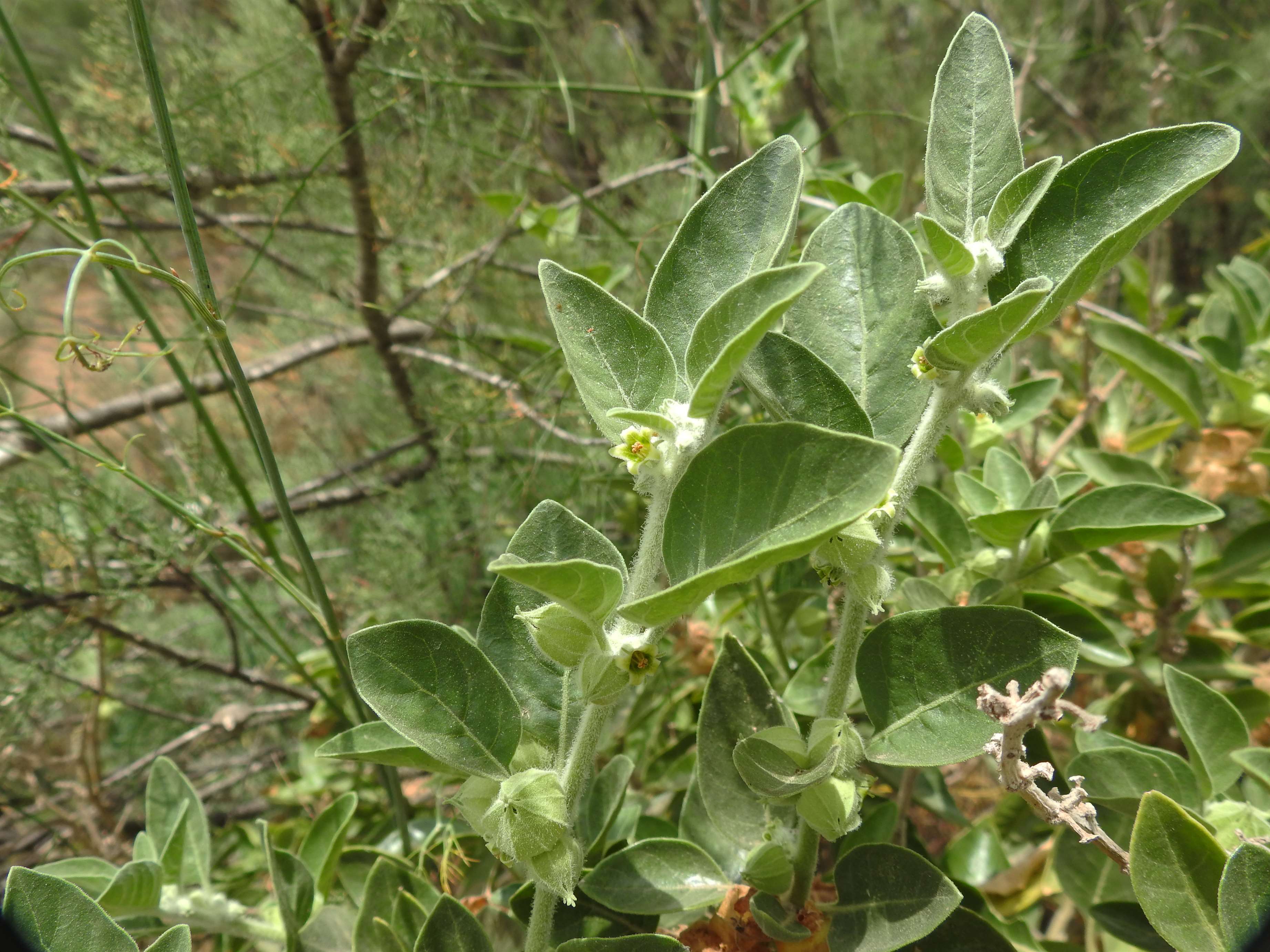
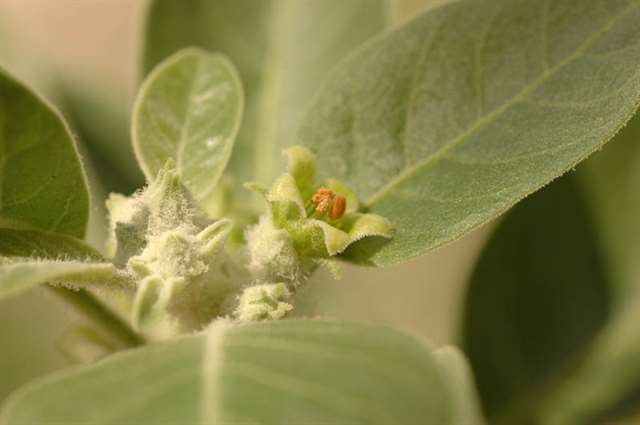
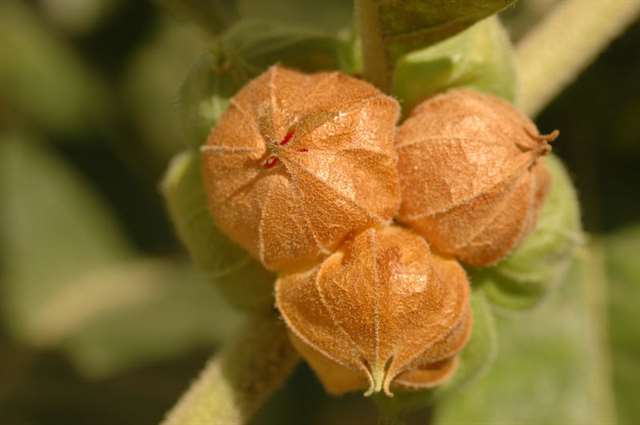
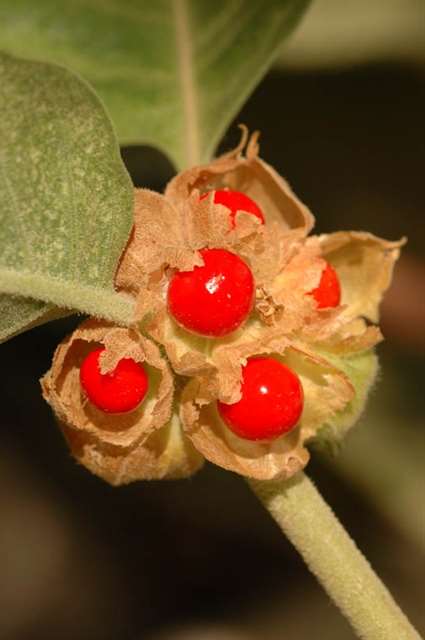
Evergreen shrub, hermaphrodite, up to 1 m in height, branched, with dense indumentum of branched, applied and white hairs. Leaves alternate, petiolate, with petiole up to 3 cm and leaf blade 9 × 7.5 cm, ovate, elliptic or oblanceolate, acute or subobtuse, cuneate at the base, green and glabrous or with some hairs along the midrib on the upper side and with white-greyish indumentum on the underside. Flowers solitary or more often geminate or in groups of up to 8 flowers, sessile or shortly pedicellate, yellowish-green; pedicel up to 3 mm with white, dense indumentum. Calyx 3-6 mm and campanulate during flowering, and up to 20 mm, urceolate and pubescent during fruiting, with 5 teeth 1.5-3 mm, linear or narrowly triangular. Corolla with 5 fused petals, 4.5-7.5 mm, campanulate, with tube 3-5 mm and 5 lobes 1.5-3.5 × 1-3 mm, densely pubescent on the external face. Stamens inserted almost at the base of the corolla tube, included, with filaments ± of the same length, glabrous. Style included. Fruit a berry of 5-8 mm, completely included in the calyx, spherical, green at first then reddish.
Flowering:
Virtually all year round, but especially during the summer.
Fruiting:
1-2 months after flowering. There can be flowers and mature fruits at the same time.
Habitat:
Edges of rivers and streams, ditches, crop margins, in ± ruderal and nitrophilous areas.
Distribution:
Southern Europe, North Africa, SW Asia and Canary and Cape Verde Islands. Relatively common in coastal and subcoastal areas from Morocco to Egypt, including the Sinai Peninsula.
Conservation status:
Common and widespread species. Currently, it has not been assessed at a global level in the IUCN Red List of Threatened Species. In the Livre Rouge de la flore vasculaire du Maroc (Fennane, 2021) it has been considered as Least Concern (LC). In the updated red list of Egypt (Shaltout & Bedair, 2023) it has been considered as Least Concern (LC).