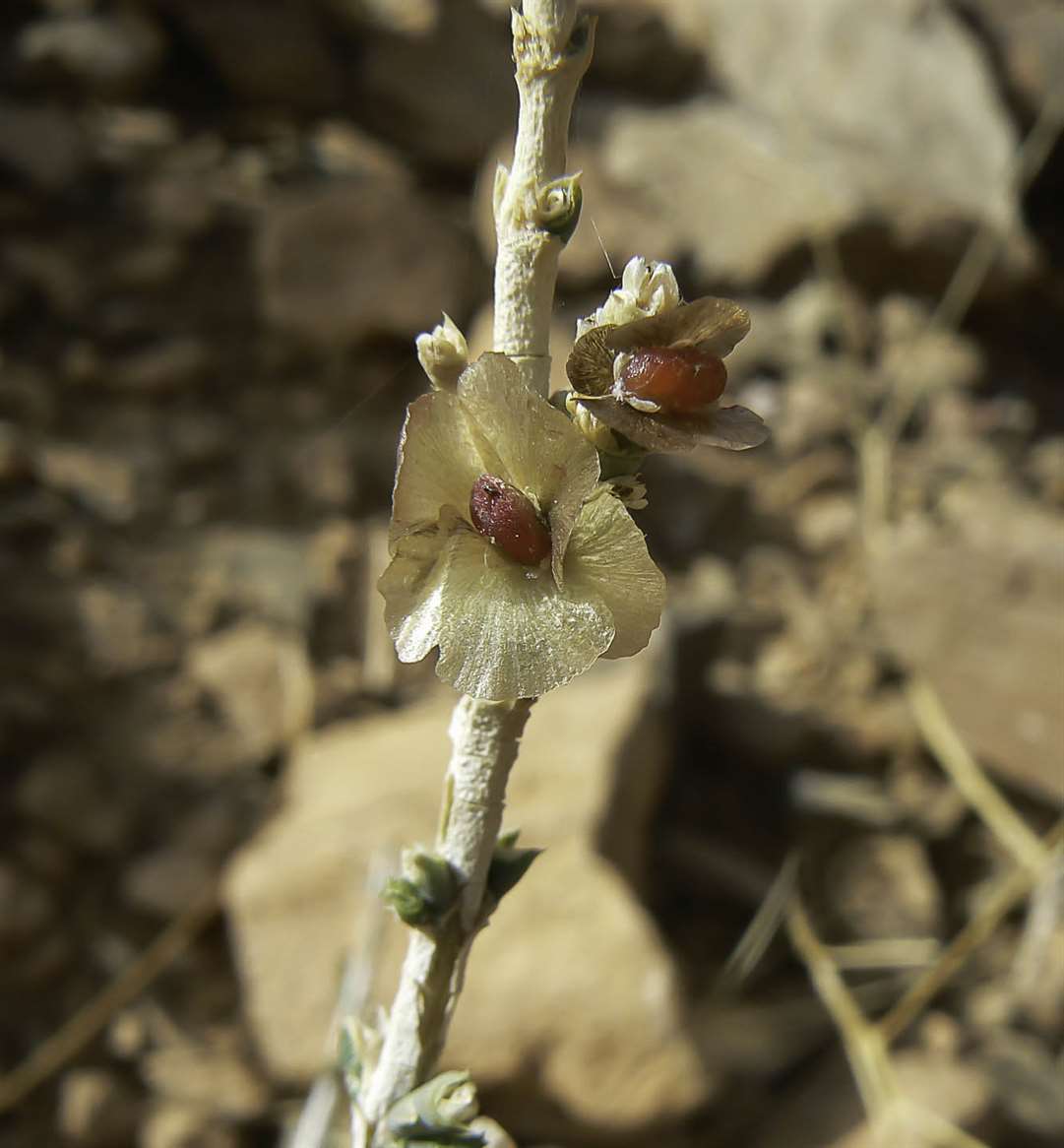
Anabasis oropediorum Maire
A. articulata subsp. oropediorum (Maire) Ozenda
Eng.: Berry bearing glasswort. Spa.: Gurullos. Fre.: Anabasis. Ara.: Adjram, ajram, aârdjam, agram, adjrem remetia, bilbal, belbel djell, bagel. Tam.: Taza, taffa, bender, abelbal, abelbel, ter’am.
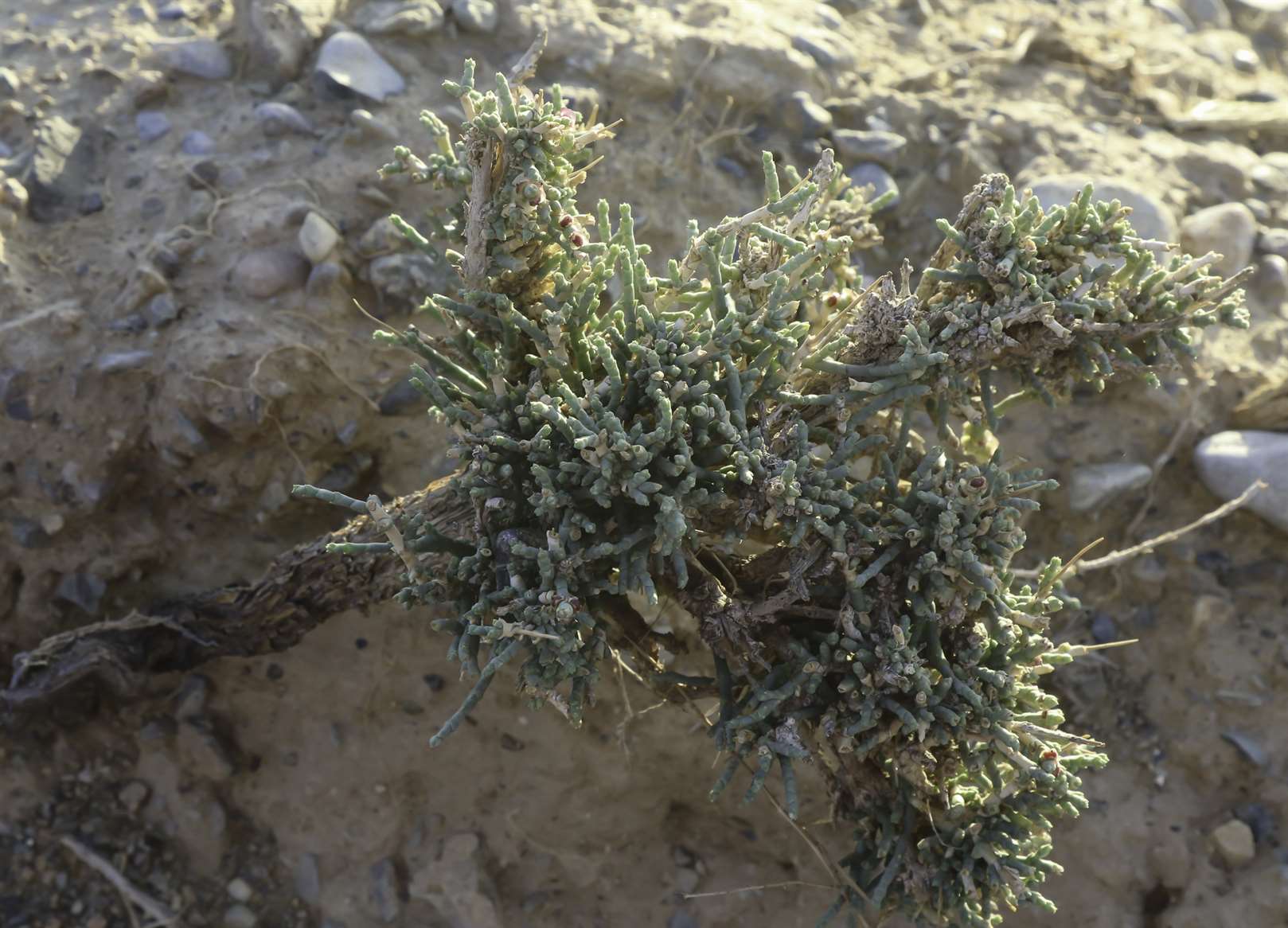
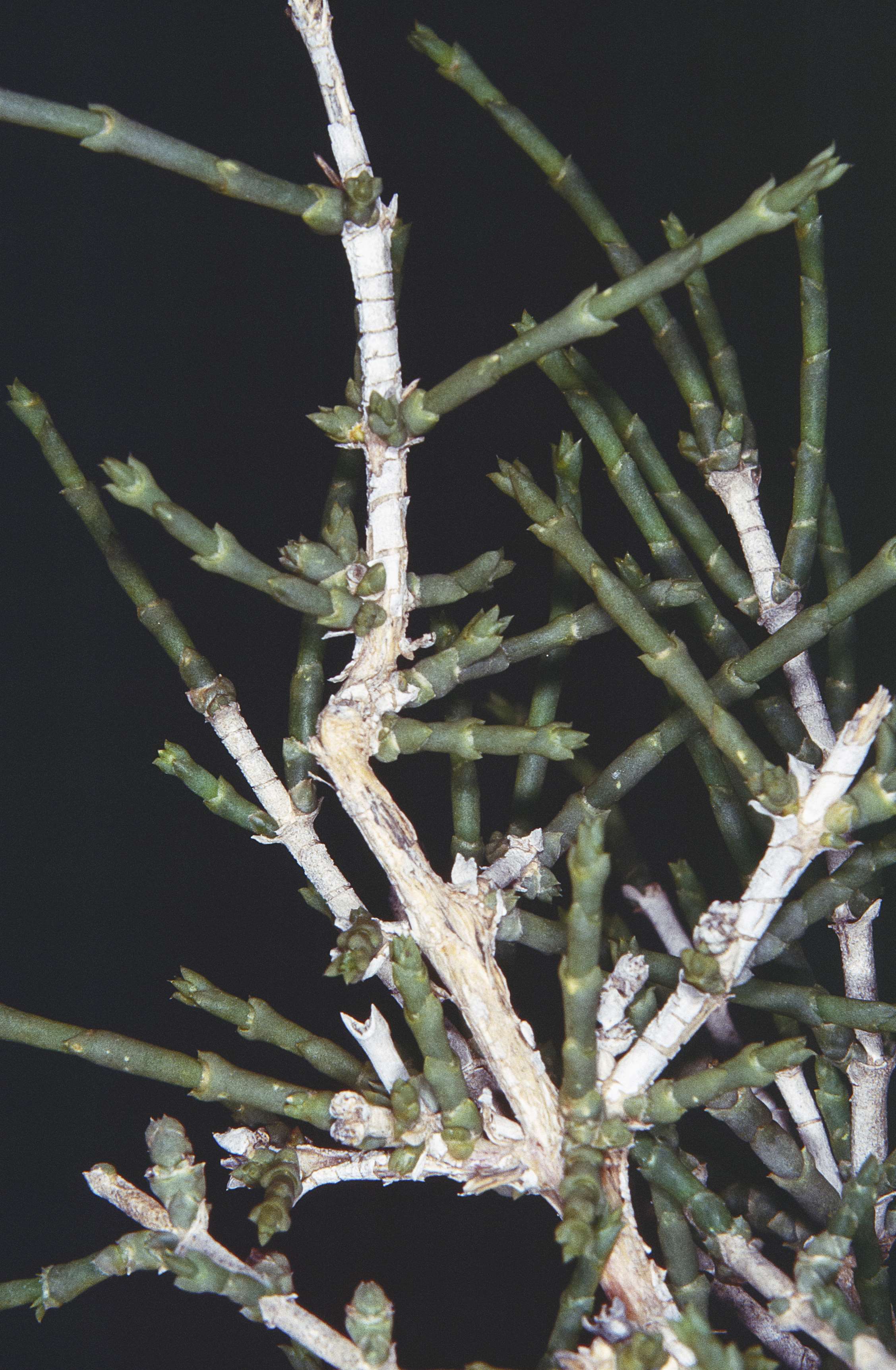
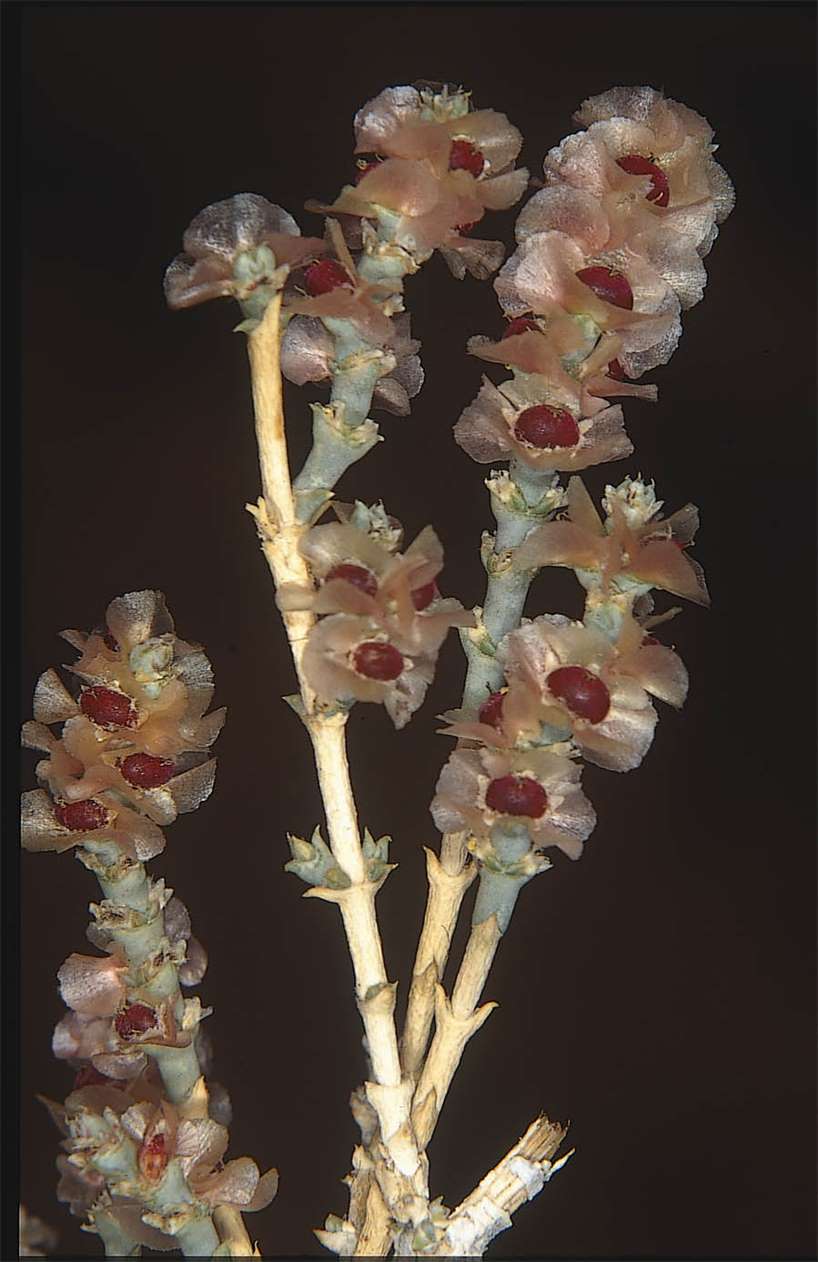
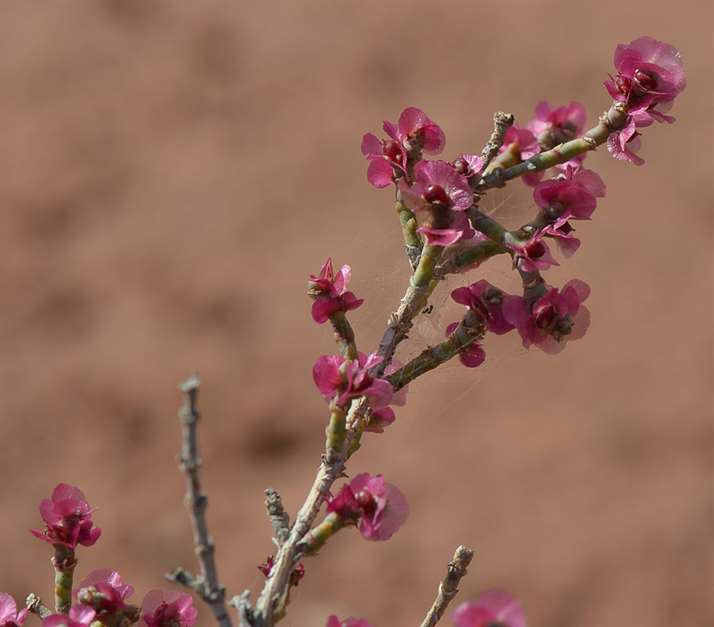
Evergreen subshrub, hermaphrodite, erect, with articulated stems highly sought by herbivores, making it very difficult to find a plant that has not been eaten to establish the natural size of this species. It could reach up to 0.8-1 m in height, but it usually grows as a subshrub, rarely exceeding 0.5 m because due to its being nibbled by animals. Main stem strongly woody, up to 4 cm in diameter. Bark greyish on the trunk, white on branches. Branchlets dark green in colour, with thin internodes (10-12 × 1.5-2 mm). Leaves opposite, very small, squamiform, amplexicaul, fused together and with the stem, forming an inverted dome with two elongated ends (up to 4 mm), with a scarious margin, ending in a tip curved backwards. It has little axillary hairiness. Flowers hermaphrodite, solitary, axillary, grouped in spiciform inflorescences at the end of the branchlets. Perianth with 5 membranous unequal parts: the 3 outer ones suborbicular, the 2 inner ones oval and narrower, all obtuse. Fruit a berry with a seed shaped as a spiral, arranged vertically. Fruit perianth with 5 white wings, pink, red or purple.
Flowering:
August to October.
Fruiting:
September to December.
Habitat:
Stony, clayey soils, in very dry, even arid climate.
Distribution:
Distributed through the driest places of the Mediterranean region and most northern areas of the Sahara: Anti-Atlas, eastern High Atlas, Saharan Atlas, plains and steppic plateaux between the Moroccan Atlas systems, the Tellian Atlas and the Saharan Atlas, central Tunisia and N of the Sahara, reaching to the SW up to the region of Zemmur (Mauritania) and to the NE up to the Sinai Peninsula.
Conservation status:
Relatively common and widely distributed species that is not considered threatened. Currently, it has not been assessed at a global level in the IUCN Red List of Threatened Species. In the Livre Rouge de la flore vasculaire du Maroc (Fennane, 2021) it has been considered as Least Concern (LC). In the updated red list of Egypt (Shaltout & Bedair, 2023) it has also been considered as Least Concern (LC).