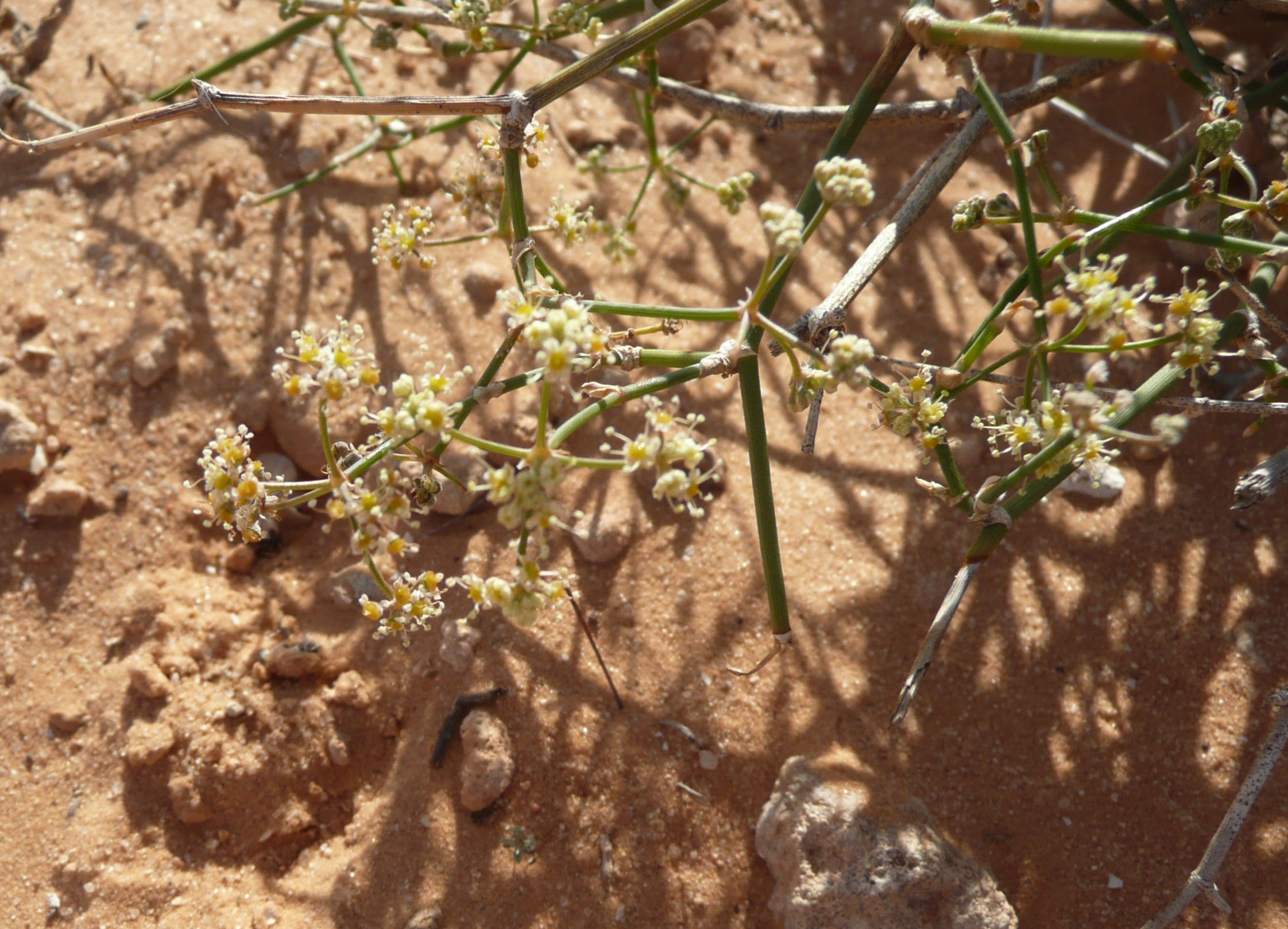
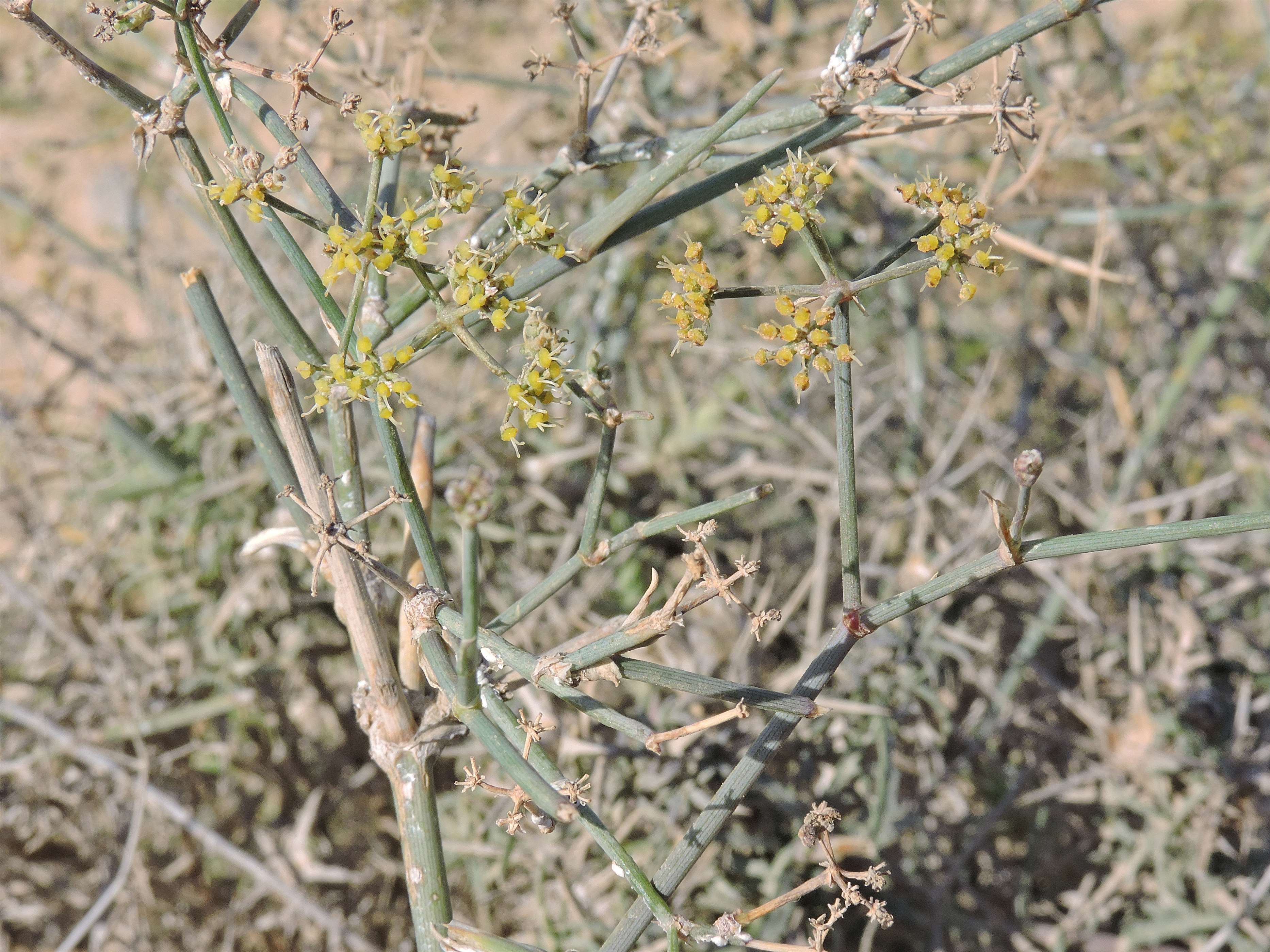
Deverra tortuosa (Desf.) DC.
Bubon tortuosum Desf., Pituranthos tortuosus (Desf.) Benth. ex Asch. & Schweinf.
Ara.: Guezza, guza, qessu, gesiche, keraui, saguh, shabat el gabal, qazzah.
Perennial subshrub, up to 0.8 m in height, with dichotomously branched stems, striated, glabrous, glaucous or whitish. Leaves deciduous; basal leaves 2-pinnatisect, with linear-subulate lobes, rigid and divergent, ovate or suborbicular, with sheathing short petioles, broad, with wide scarious margins; lower cauline leaves with broad sheaths and very short ternatisect leaf blade; upper cauline leaves reduced to sheaths with filiform apices. Umbels mostly terminal, with 6-10 subequal rays. Flowers semi-closed, slightly open, with petals almost glabrous or scarcely puberulent along the green vein of the underside. Fruit a double achene, 1-1.5 mm, shorter than the pedicel, from ovoid to almost globose, hirsute.
Flowering:
April to May(September).
Fruiting:
May to July (October).
Habitat:
In deserts, mainly in depressions or beds of watercourses.
Distribution:
Tunisia, Libya, Egypt, Palestine, Israel and Saudi Arabia.
Observations:
Strongly aromatic plant, the leaves and tender shoots are widely used as seasoning. Highly palatable to livestock, especially camels; it is widely consumed during the summer.
Conservation status:
Fairly rare species, but widely distributed. Currently, it has not been assessed at a global level in the IUCN Red List of Threatened Species. In the updated red list of Egypt (Shaltout & Bedair, 2023) it has been considered as Least Concern (LC).