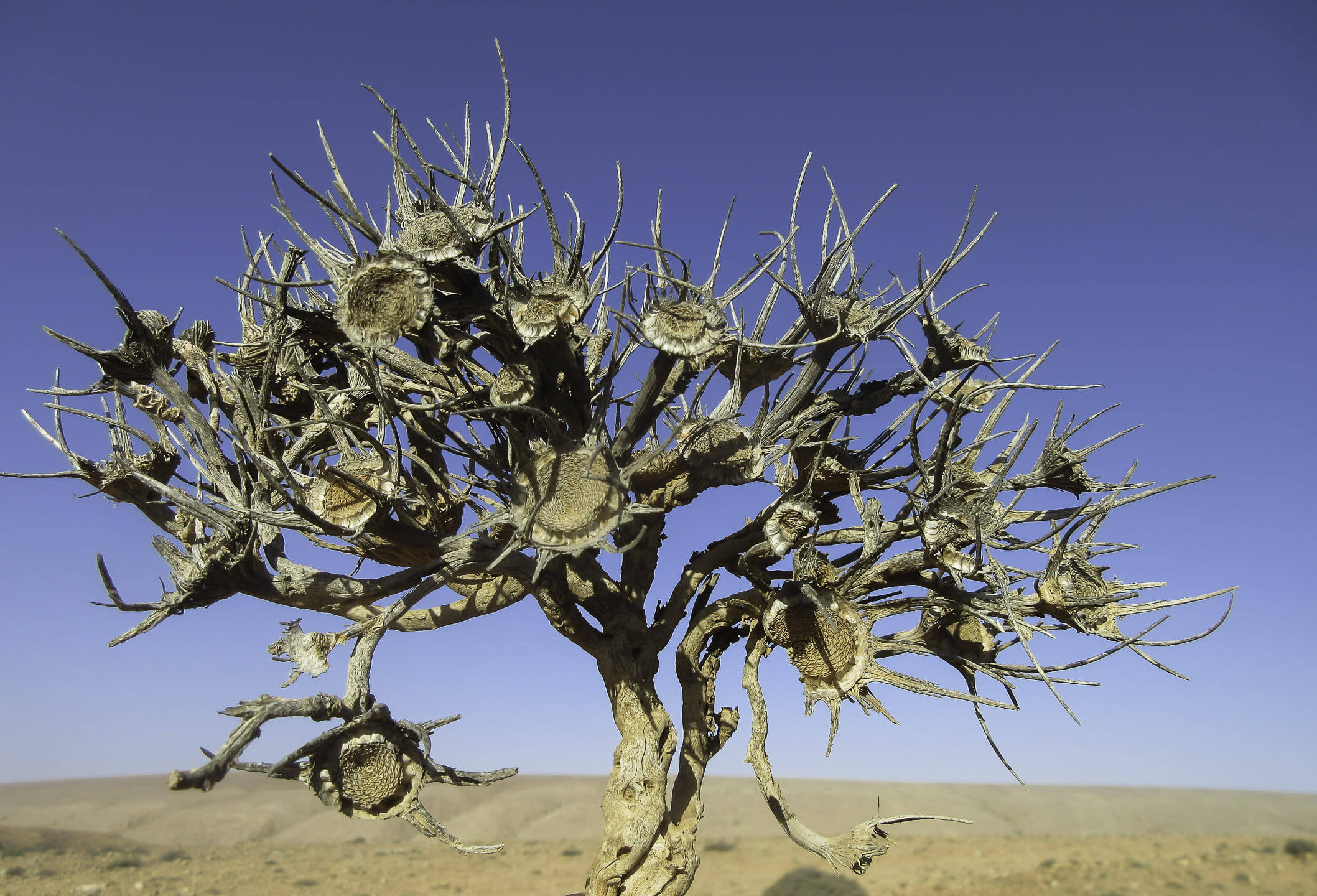
Anvillea garcinii (Burn.f.) DC.
Fre.: Anvillea radiée. Ara.: Horf, arfedj, aârfedj, kerfedj, aïn el begra, chedjeret ed dhob, neggud, nuged, nugd, nogd, mankuch, ajig, awjerd, ajri. Tam.: Crammuch, tehetit, akadkad, akatkadh.
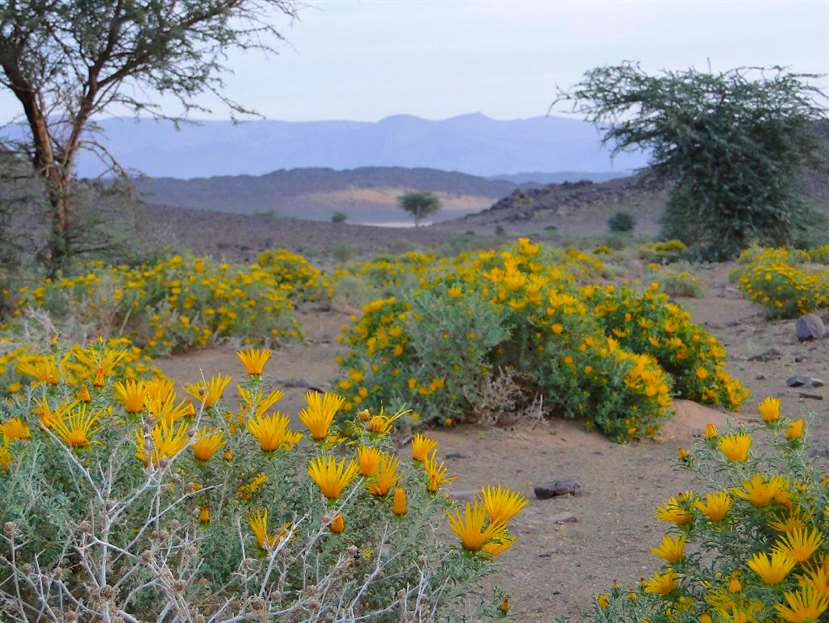
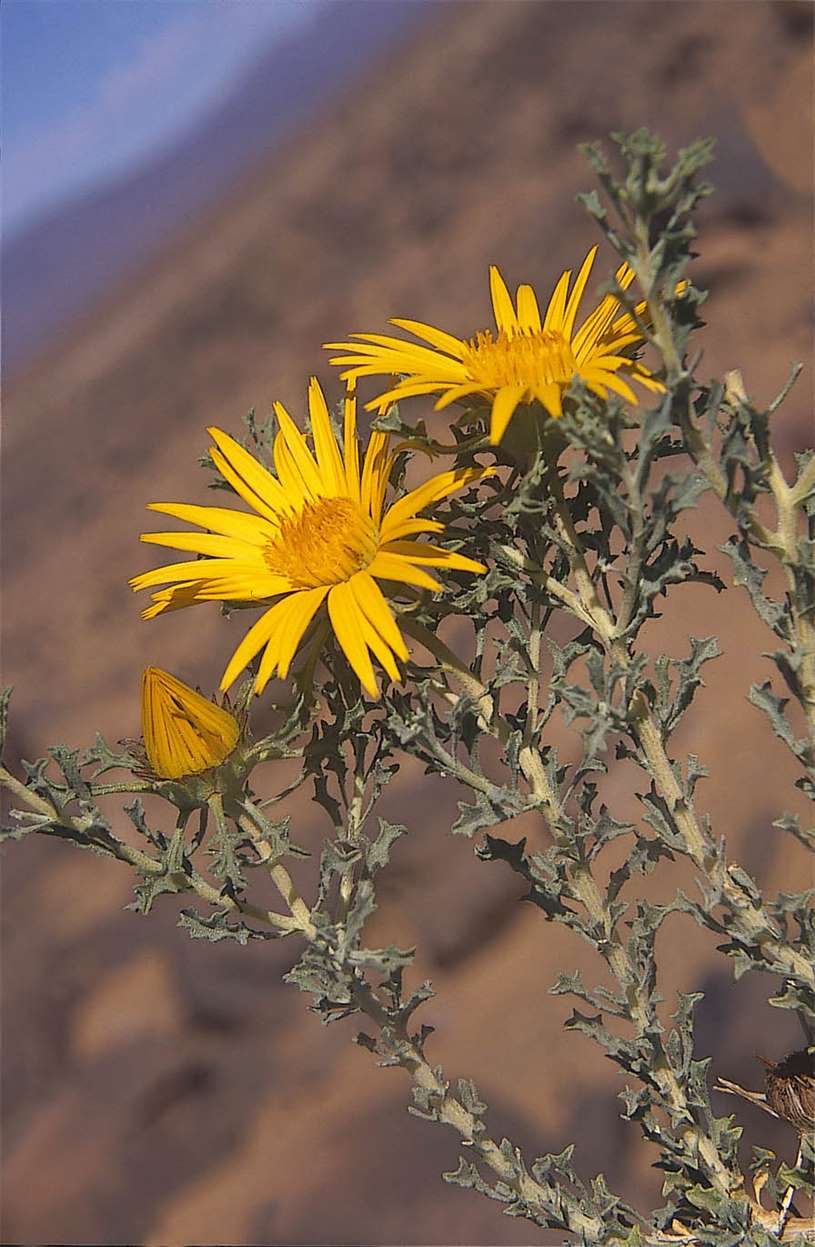
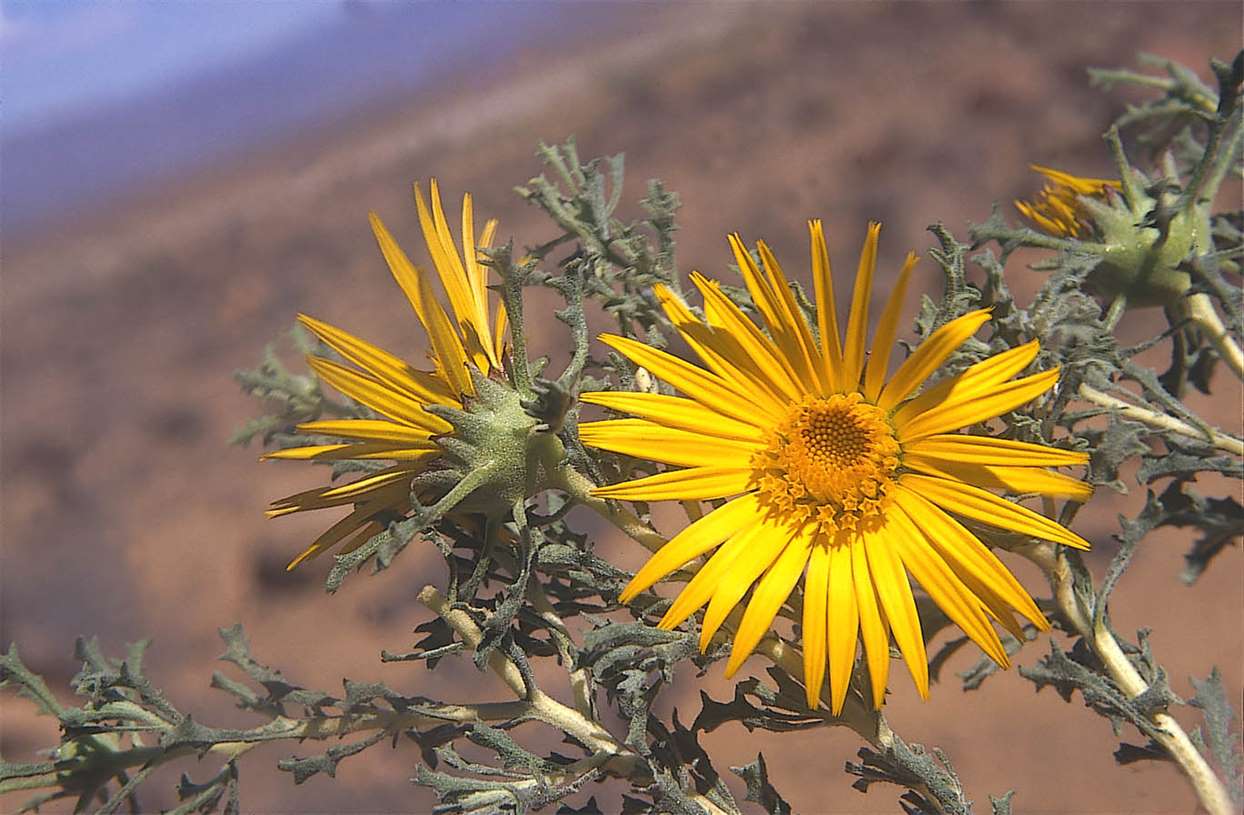
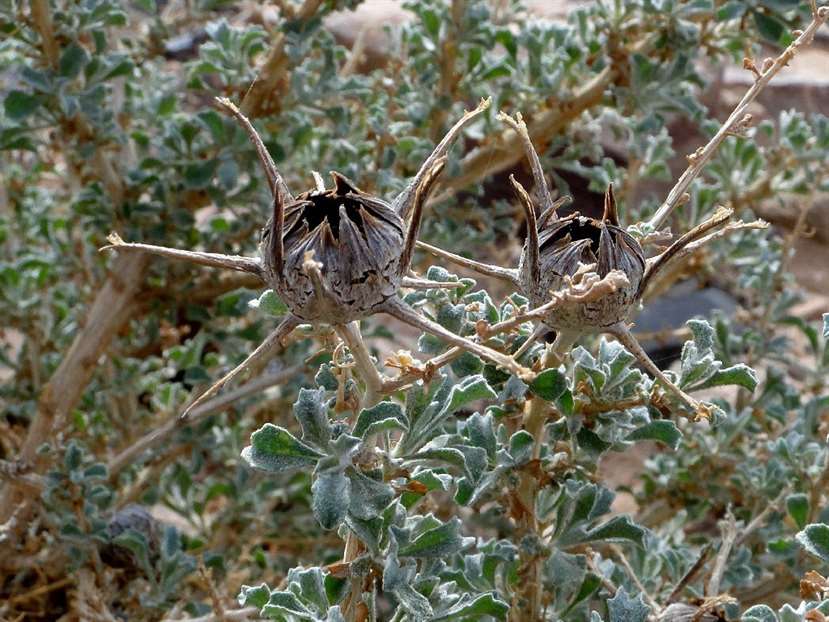
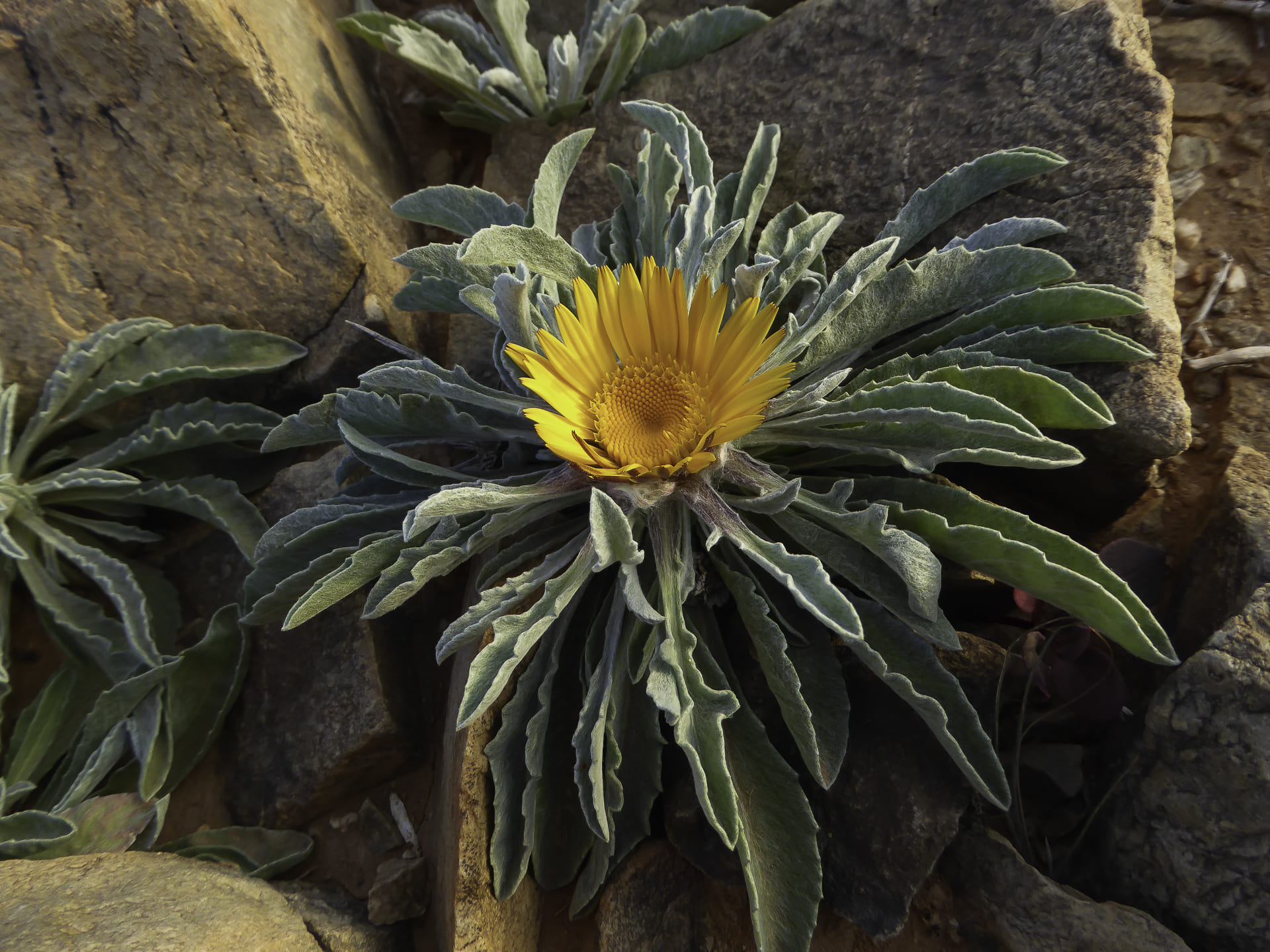
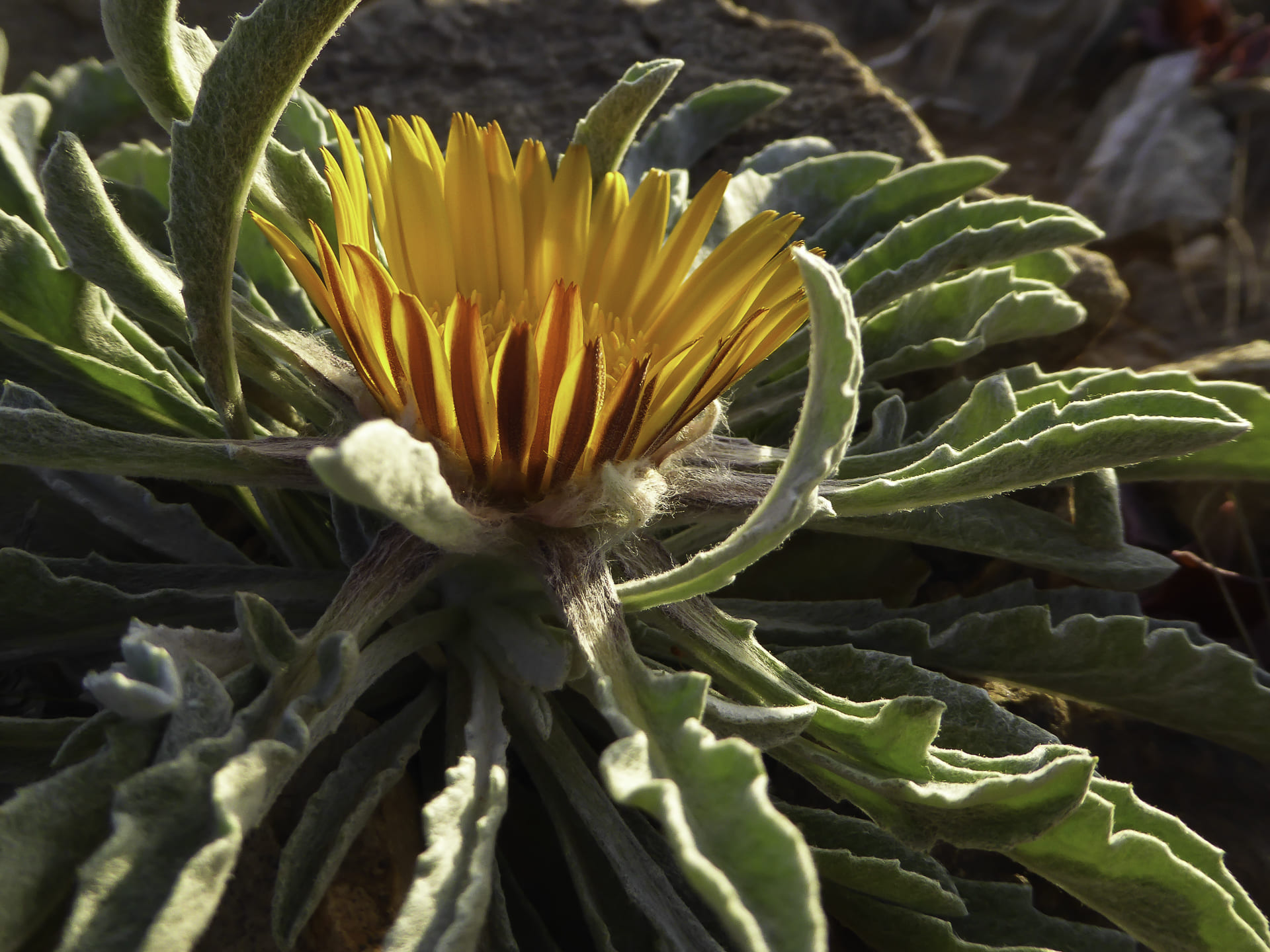
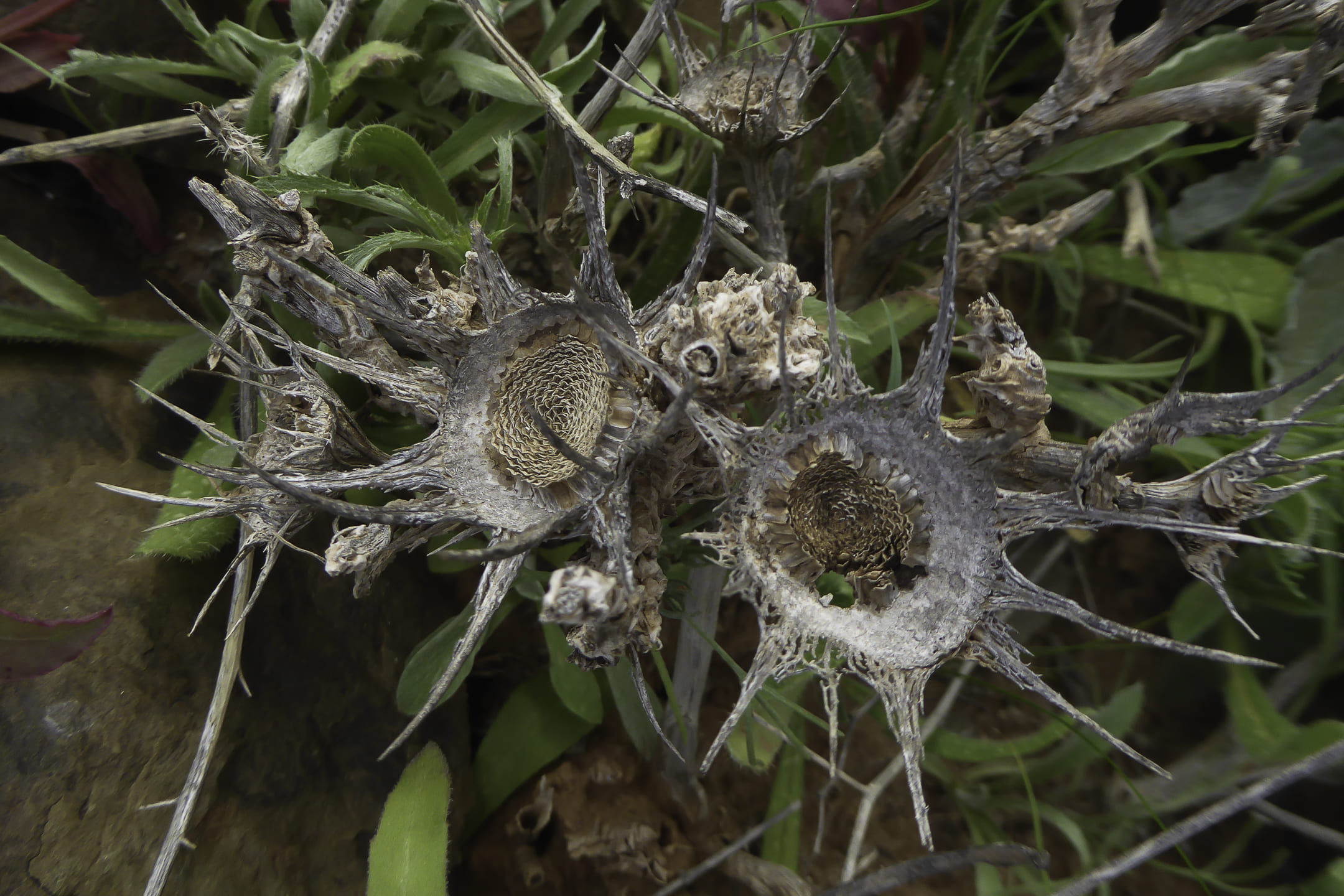
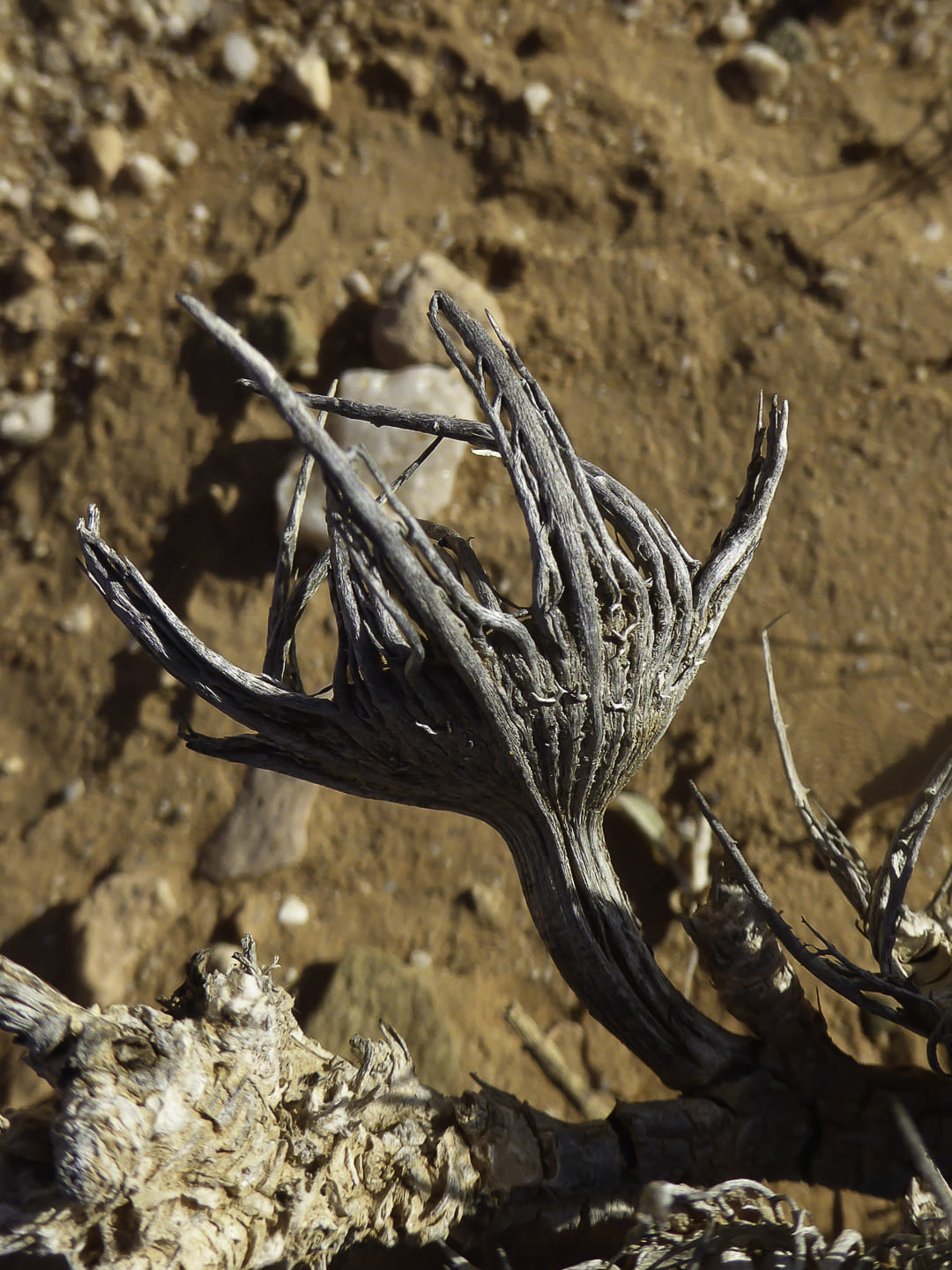
Subshrub, evergreen, hermaphrodite, up to 0.5(0.6) m in height, very ramose, erect, greenish-whitish in overall appearance, tomentose-pubescent. Stems and old branches woody, tortuous, with greyish bark. Young branchlets greenish-whitish, covered by a tomentum of sparse white hairs. Leaves (0.6-2.5 × 0.3-0.8 cm) obovate-spatulate, alternate or subopposite, lobulate-dentate and undulate in the terminal half, entire and very tapered towards the base, greyish-green, with tomentum of white very short hairs. Capitula terminal, solitary, about 3 cm in diameter, surrounded by several rows of involucral leaves, spatulate and spiny, longer than the involucre. Involucre with 3-5 rows of bracts, imbricate, lanceolate, fused on the lower half and hardened at fruiting. Receptacle flat, with interfloral scales surrounding the flowers. Flowers yellow; outer flowers in ray florets (with 3 lobes) and female; inner flowers in disc florets and hermaphrodite. Achenes 3-5mm, with 3-4 longitudinal ribs, without pappus; outer achenes tetragonal; central achenes trigonous and with clear ribs but not winged.
Flowering:
February and March.
Fruiting:
April to July.
Habitat:
Tickets and Saharan and sub-Saharan grasslands.
Distribution:
Northern and eastern Sahara, from Morocco to Egypt, including the Sinai Peninsula.
Observations:
In North Africa it is represented by the subsp. radiata (Coss. & Durieu) Anderb. (A. radiata Coss. & Durieu), with a distribution area that extends into the Iberian Peninsula. The other species, also North African, is A. platycarpa (Maire) Anderb., endemic to the western Sahara in Morocco, where it is highly localised (Tiglet, El-Aïoun Drâa, SW Messeïed) in stony steppes and gravel areas in wadis. It is a much more tomentose plant than A. garcinii and smaller in size, not exceeding 20 cm in height. Capitula, however, are larger (about 4 cm in diameter) and are surrounded by a single row of involucral leaves longer than the involucre, and its achenes are flattened, with 2 lateral wings and 2 small apical horns.
Conservation status:
A. garcinii is a common and widespread species; however, A. platycarpa is rarer and with a smaller distribution area. Currently, they have not been assessed at a global level in the IUCN Red List of Threatened Species. In the Livre Rouge de la flore vasculaire du Maroc (Fennane, 2021) A. garcinii has been considered as Least Concern (LC) and A. platycarpa como as Endangered (EN). In Algeria, A. garcinii is included as A. radiata subsp. australis in the List of protected non cultivated flora (Executive Decree 12-03 on 4-Jan-2012).