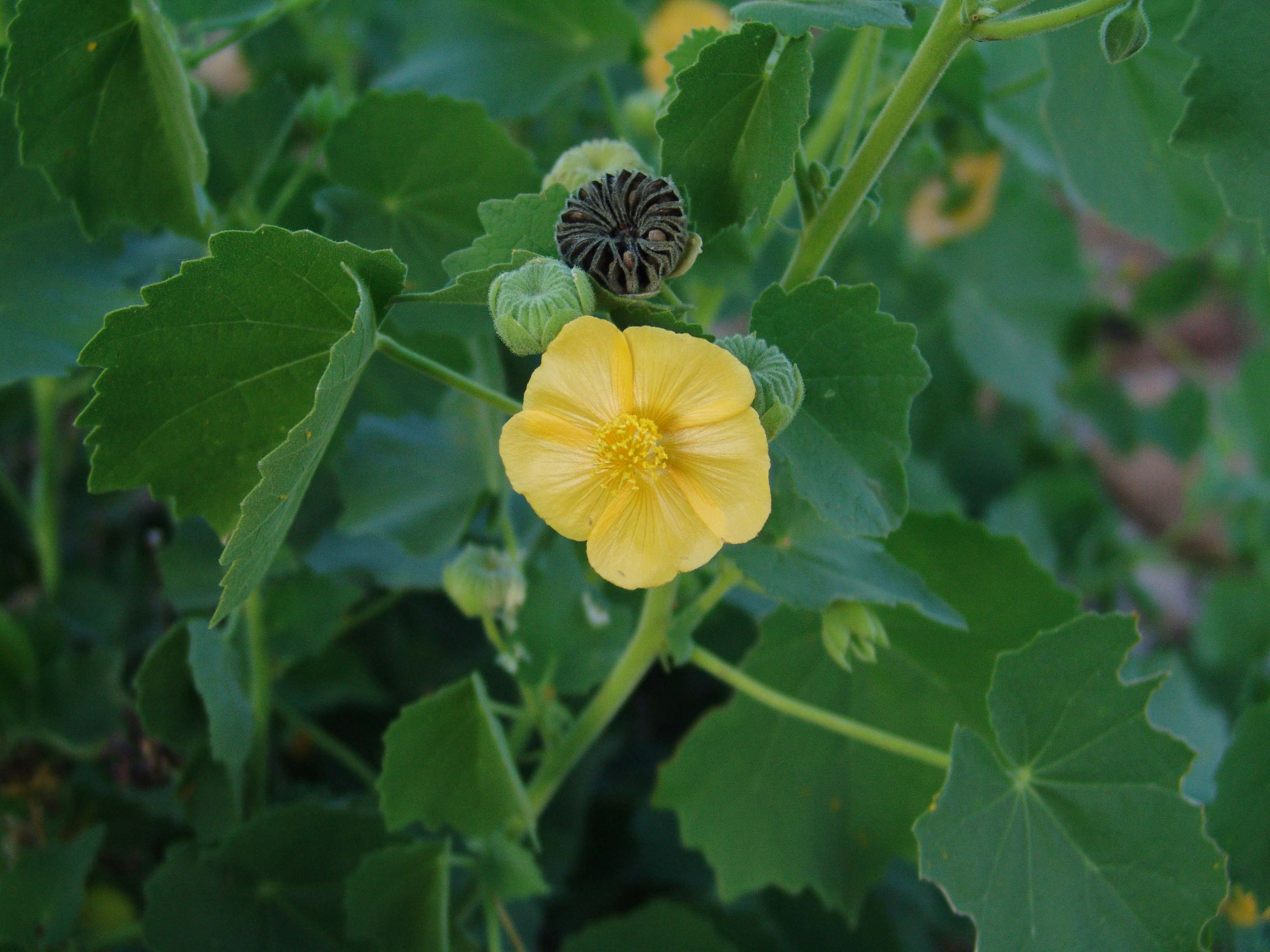
Abutilon bidentatum (Hochst.) A. Rich.
A. microcarpum Mattei, A. indicum var. major Blatt. & Hallb.
Ara. (Egypt): Amborao.
Herbaceous perennial plant or subshrub, up to 1(1.5) m in height, with highly branched stems, younger stems pubescent-tomentose, sometimes also with long simple hairs. Leaf blade 2.5-12 × 2-10 cm, usually ovate, with roughly serrated margin, green on the upper side, grey on the underside, cordate, with acuminate or acute apex. Petiole 3-10 cm. Stipules 6-9 mm, subulate, caducous. Flowers 1.8-2 cm in diameter, usually in small panicles, sometimes solitary or in pairs. Calyx 0.8-1.1 cm, pubescent on both sides, slightly accrescent at fruiting, with triangular acuminate lobes. Petals 1.5-1.8 cm. Fruit with 12-17 mericarps, accrescent at maturity, 6-10 × 3-5 mm, acute, pubescent. Seeds 2-3 in each mericarp, 1.5-2.5 mm, papillose, brown.
Flowering:
In autumn-winter in the areas close to the coast of the Red Sea.
Fruiting:
Late autumn and winter.
Habitat:
Savannahs; riparian forests, riverbanks, thickets, on stony and rocky soils, ± sandy colluvial zones.
Distribution:
From central Sahara to China, reaching towards the S to the S of Mozambique in Africa. In North Africa, it grows in the mountainous massifs of the central Sahara, Air (Niger) and Tibesti (Chad), and in Egypt, Sudan and Eritrea.
Conservation status:
Common and widely distributed species. Currently, it has not been assessed at a global level in the IUCN Red List of Threatened Species. In the Red List of vascular plants of Egypt (Flora Aegyptiaca Vol 1, 2000) it is listed as “Vulnerable”.