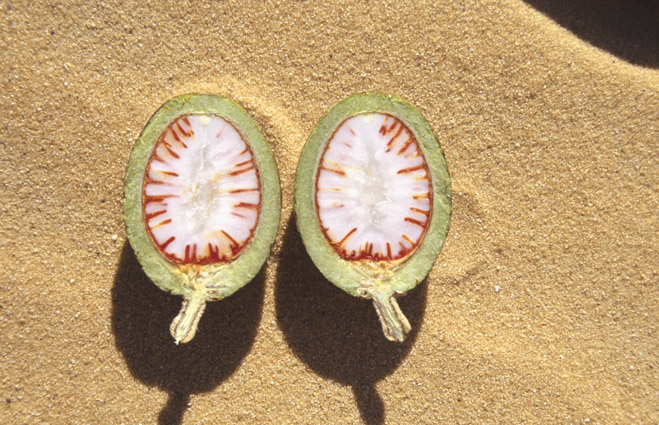
Medemia argun (Mart.) H. Wendl.
Hyphaene argun Mart., M. abiadensis H. Wendl.
Eng.: Argun palm. Spa.: Palmera argun. Fre.: Palmier argoun. Ara.: Argun.
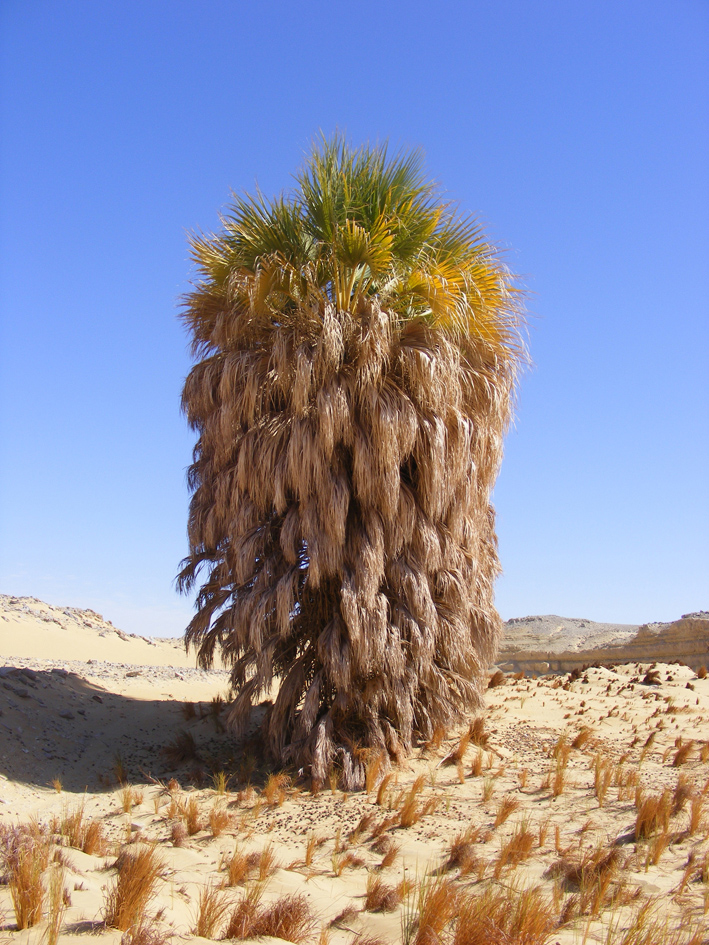
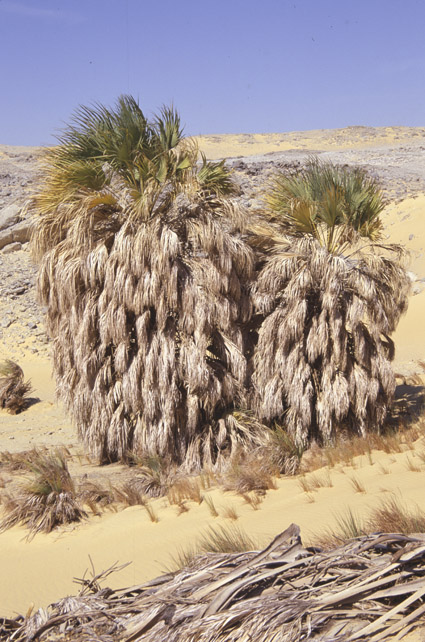
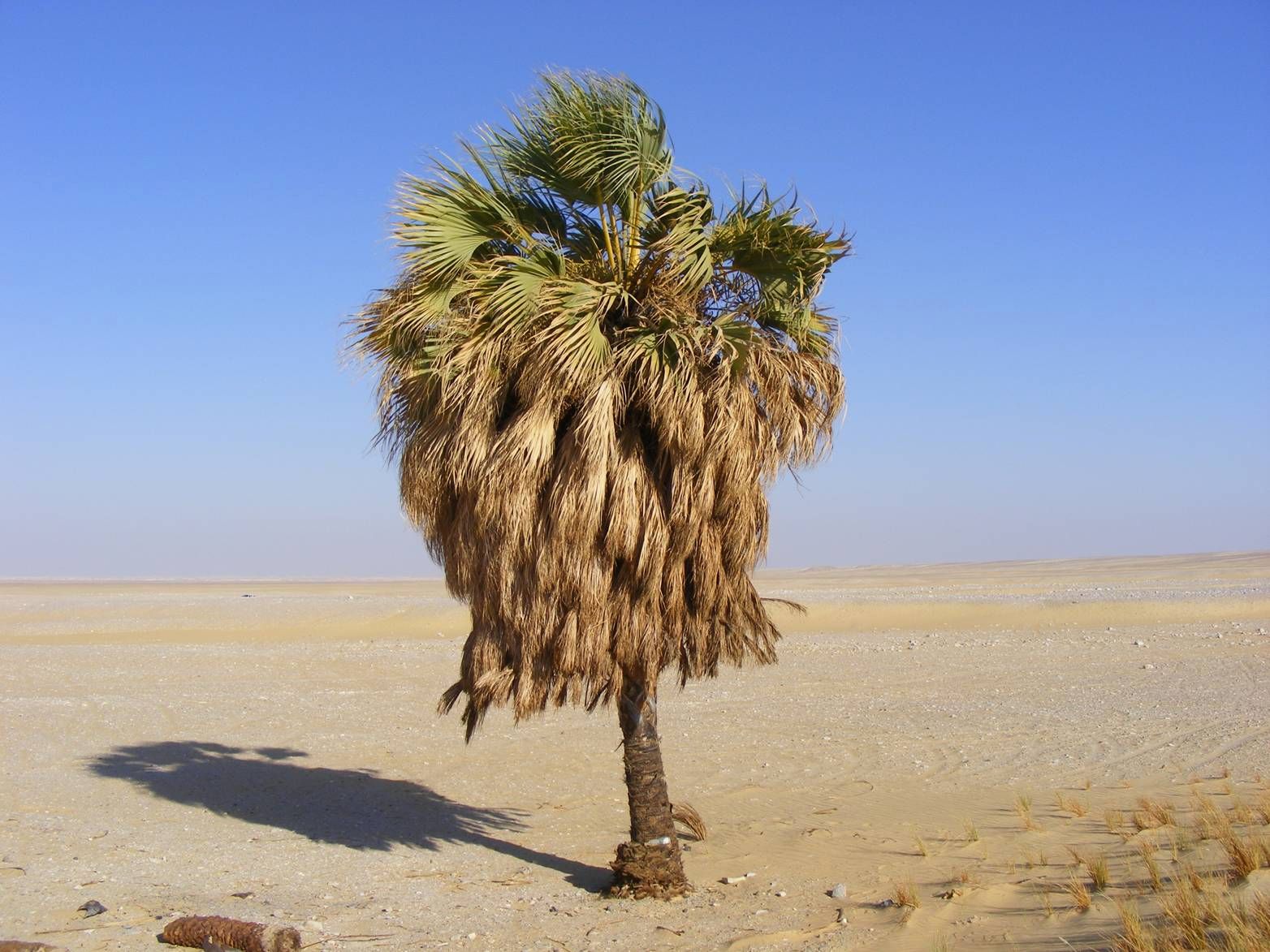
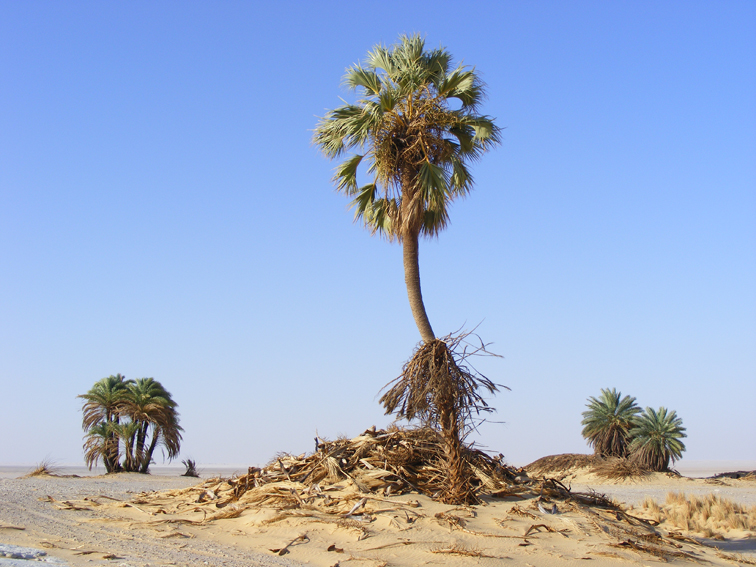
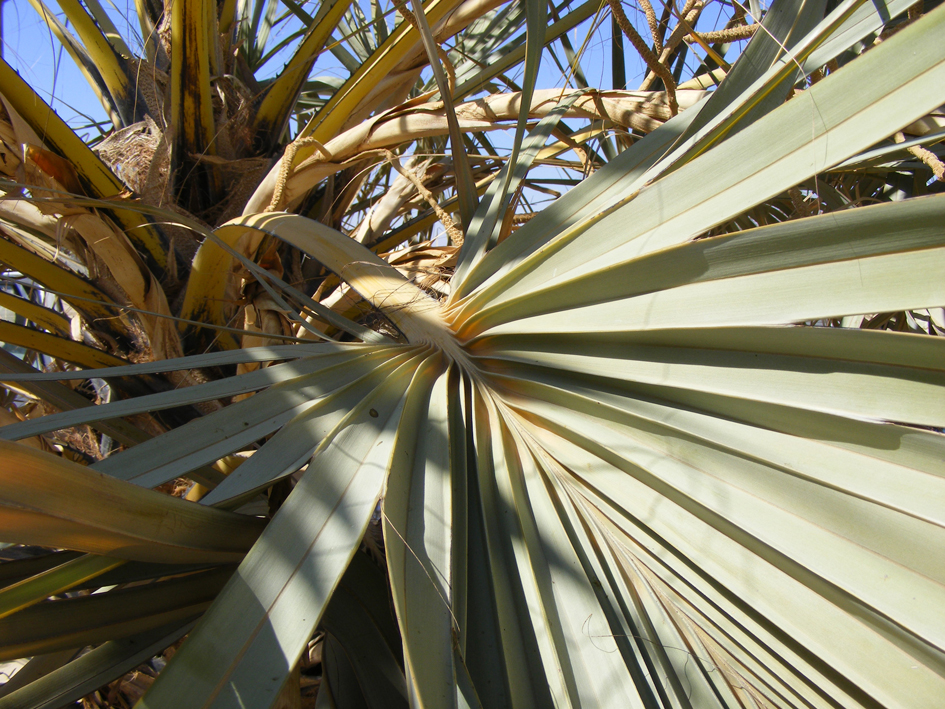
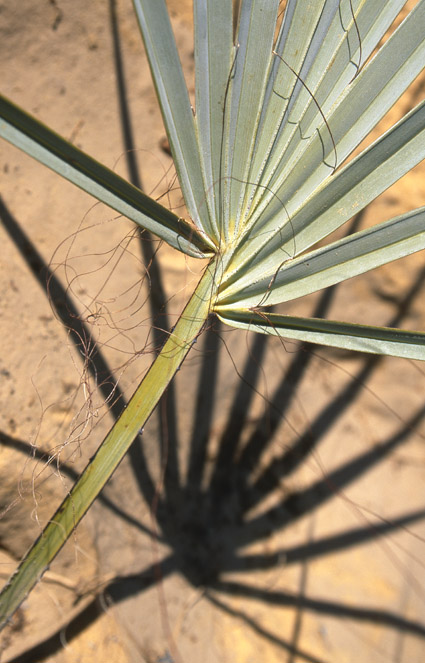
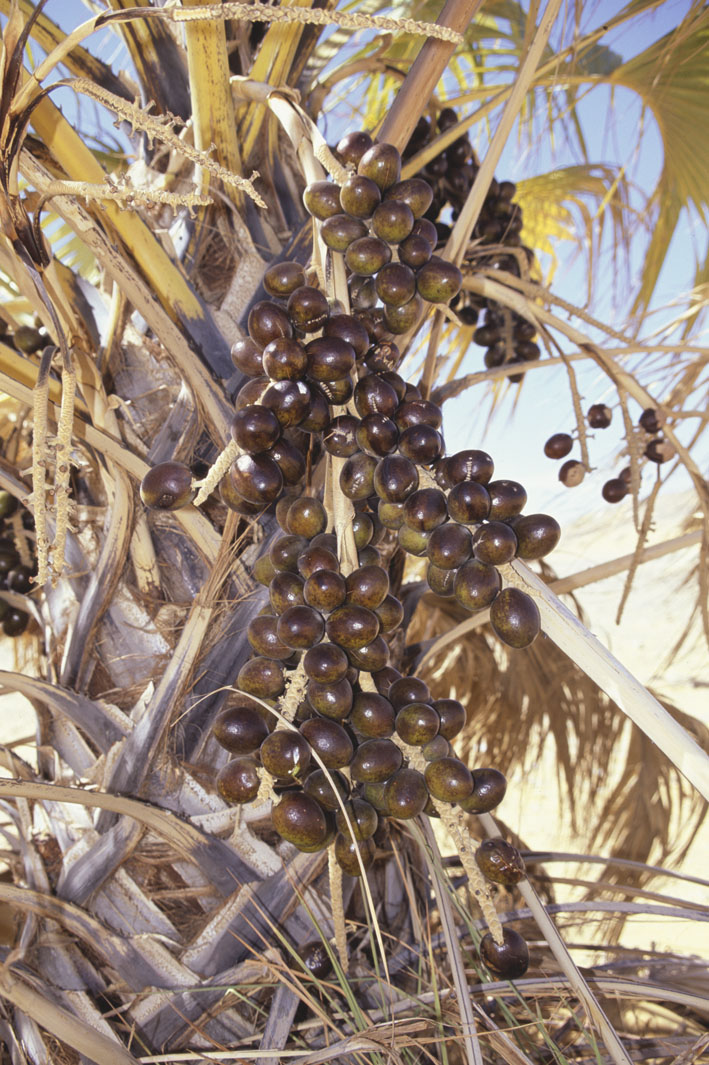
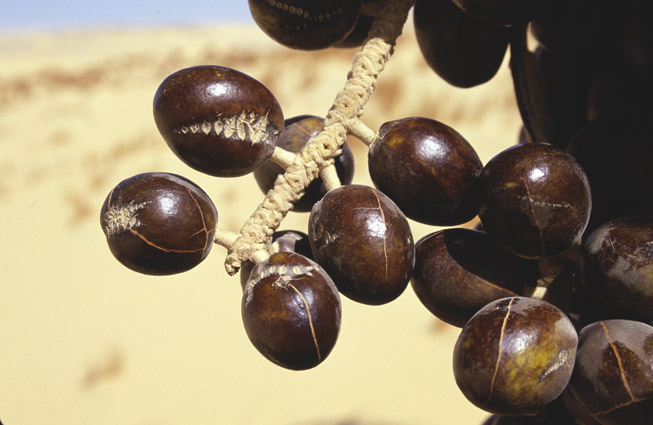
Tree up to 10 m in height, evergreen, dioecious, straight, fibrous trunk, covered with the remains of the base of the old leaves, that stay on the trunk several years before falling. Leaves up to 1.5(2) m long, forming a large tuft at the apex of the trunk, with glaucous green leaf blade and plane-convex petiole, the latter bright yellow with a black margin, and thick, short, marginal spines, antrorse, black. Inflorescence a compound spadix, with several spiciform branches; spadix pendulous, surrounded by spathes. Flowers unisexual; male flowers with a perianth of 6 tepals arranged in 2 whorls, and 6 stamens also arranged in 2 whorls; female flowers with a perianth of 6 parts arranged in 2 whorls and a superior ovary with 3 free carpels, of which 2 will abort before ripening. Fruit a drupe 6-7 × 5-6 cm, purple-black when mature.
Flowering:
March to May.
Fruiting:
No data for this region
Habitat:
In oases and wadis of the Nubian Desert, where there can be no rainfall for several years.
Distribution:
It is restricted to the Nubian Desert in S Egypt (Dungul and Nakhila Oasis, Wadi Allaqi and tributaries) and in the N of Sudan (Wadi Shagrib, Murray wells, etc.).
Observations:
The fruit of this plant was well known in Ancient Egypt, frequently appearing among funerary offerings in tombs. But the plant was unknown, until a few palms with the corresponding fruits were found in 1837 in the N of Sudan, in the Nubian Desert. The palm was described by Carl von Martius in 1845 with the name H. argun as a new species of the genus Hyphaene Gaertn. But given the peculiar characteristics of these plants, the German botanist Hermann Wendland created, in 1881, the genus Medemia with 2 species, currently considered synonyms. It was not found in Egypt until the early twentieth century, also in the Nubian Desert. They normally grow as isolated individuals or in small groups usually of no more than 7 or 8 plants. The fragility of the areas where this rare palm tree grows, and the local use of its leaves, threatens the survival of this species in the wild.
Conservation status:
Very rare and threatened species. In the IUCN Red List of Threatened Species it is listed at a global level as Critically Endangered (CR) (Johnson, D. 1998). In the updated red list of Egypt (Shaltout & Bedair, 2023) it has been considered as Critically Endangered (CR).