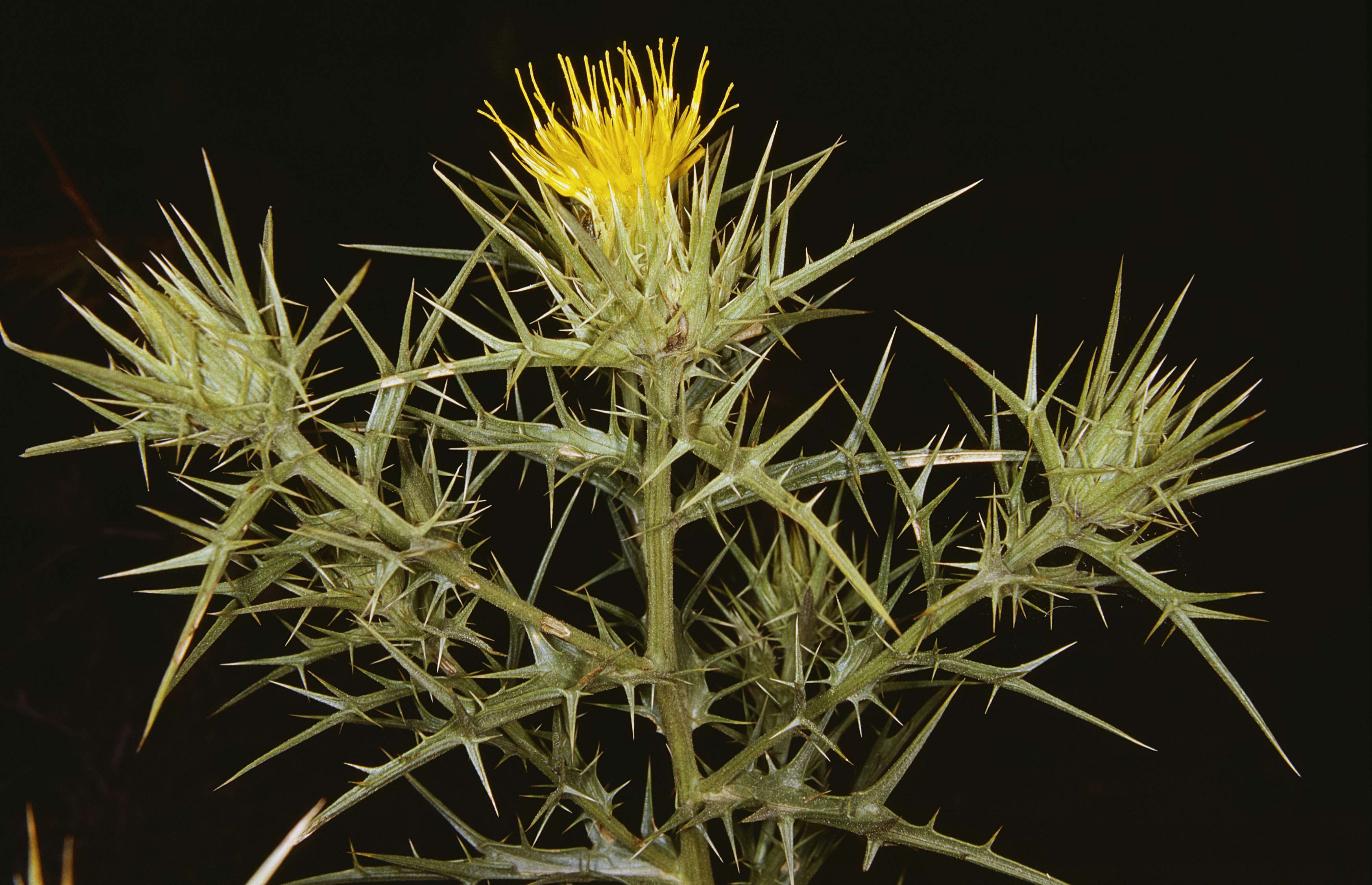
Carthamus riphaeus Font Quer & Pau
Phonus riphaeus Font Quer & Pau
Spa.: Cardo rifeño. Fre.: Carthame du Rif.
Shrub, very spiny, evergreen, hermaphrodite, up to 1.5(3) m in height, very ramose, upright, with trunk and branches strongly lignified, greyish-yellowish. Leaves alternate, much narrower than in the previous species (lanceolate or linear-lanceolate), with lobes also narrower (lanceolate-spinescent), very rigid and spinescent, greenish-yellowish on both sides. Inflorescence in solitary capitula, terminal and axillary (3-4.5 × 1-2 cm), narrowly ovoid, with the base of the involucre surrounded by bracts very similar to leaves, ± twice as long as the capitulum; the other involucral bracts ± ovate-lanceolate, entire or dentate-spinescent. Flowers tubular, regular, without ligules, very protruding above the bracts, yellow. Fruit a small subtetragonal elongated achene, with a light brown surface and pappus of caducous hairs, which fall easily when touched.
Flowering:
May to August.
Fruiting:
July to September.
Habitat:
Thickets and grasslands on clayey, loamy or gypsum soils, sometimes in rocky outcrops, at low altitude. From semiarid to subhumid bioclimate, on thermomediterranean and lower mesomediterranean floors.
Distribution:
Endemic to the Rif (Morocco), highly localised in thickets and grasslands of the inland central Rif, reaching towards the S to Bab Marzuka, near Taza. Despite of being isolated in a small distribution area, in some localities this shrub is relatively abundant.
Conservation status:
Not a common species and with a small distribution area. Currently, it has not been assessed at a global level in the IUCN Red List of Threatened Species. In the Livre Rouge de la flore vasculaire du Maroc (Fennane, 2021) it has been considered as Endangered (EN).