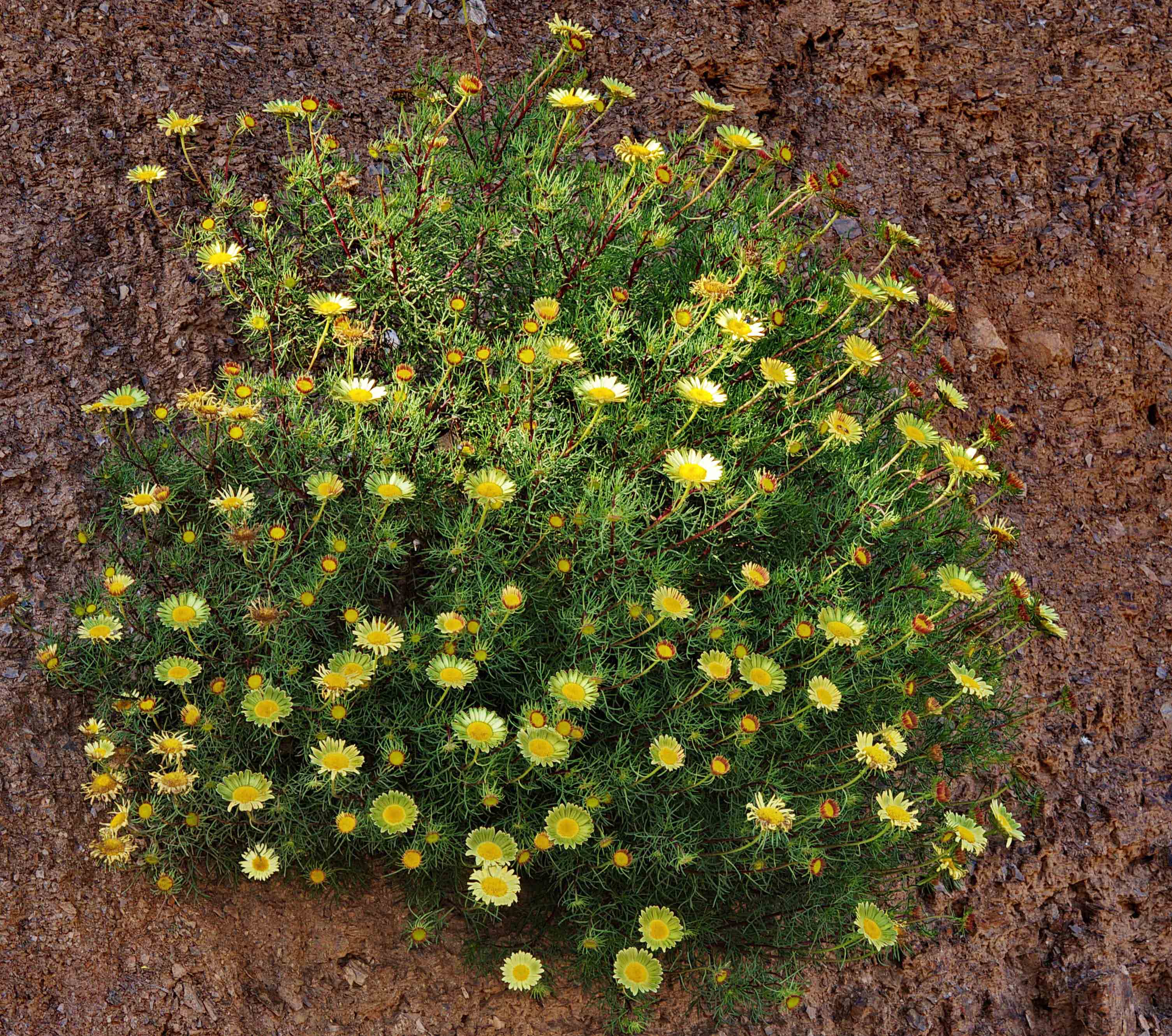
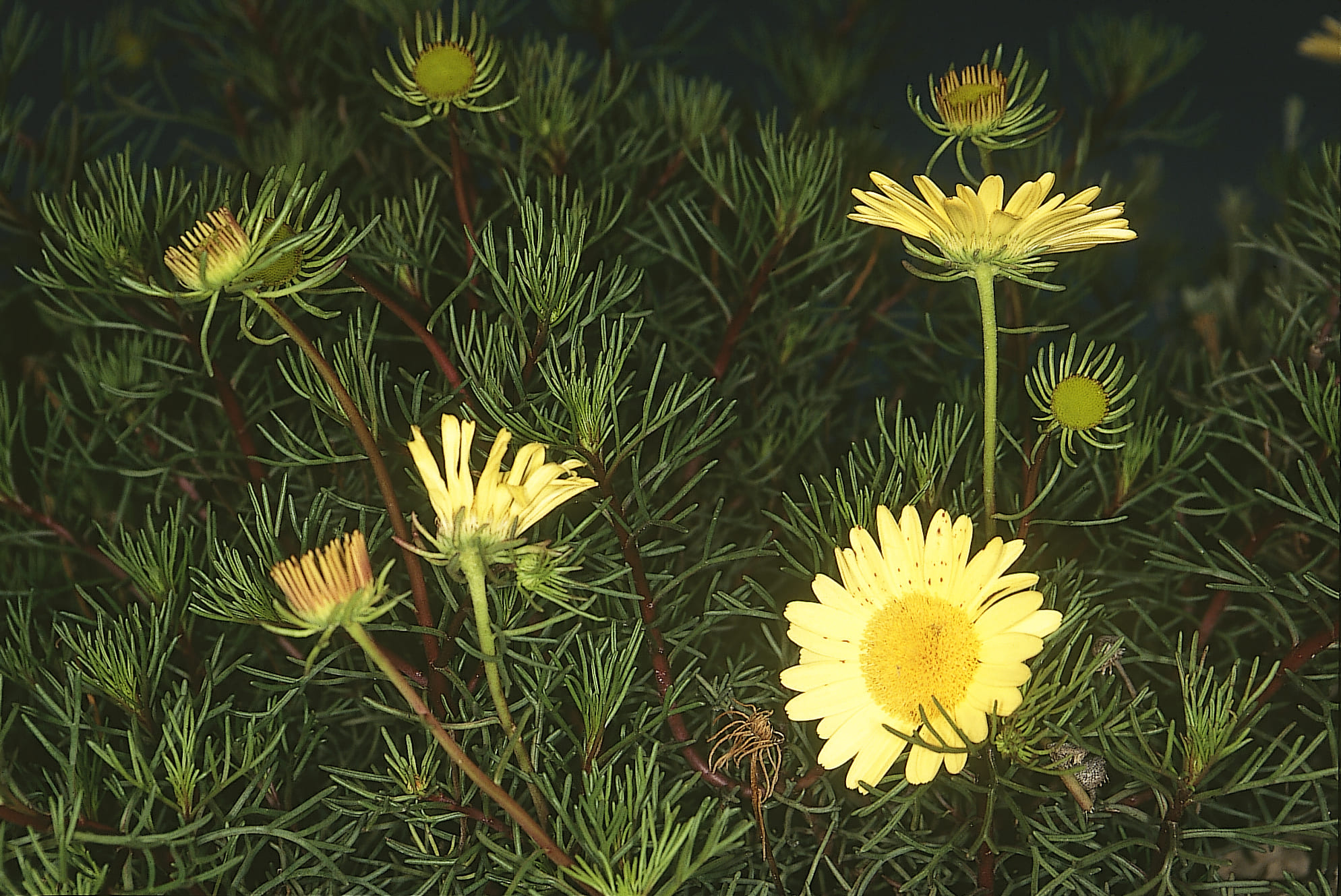
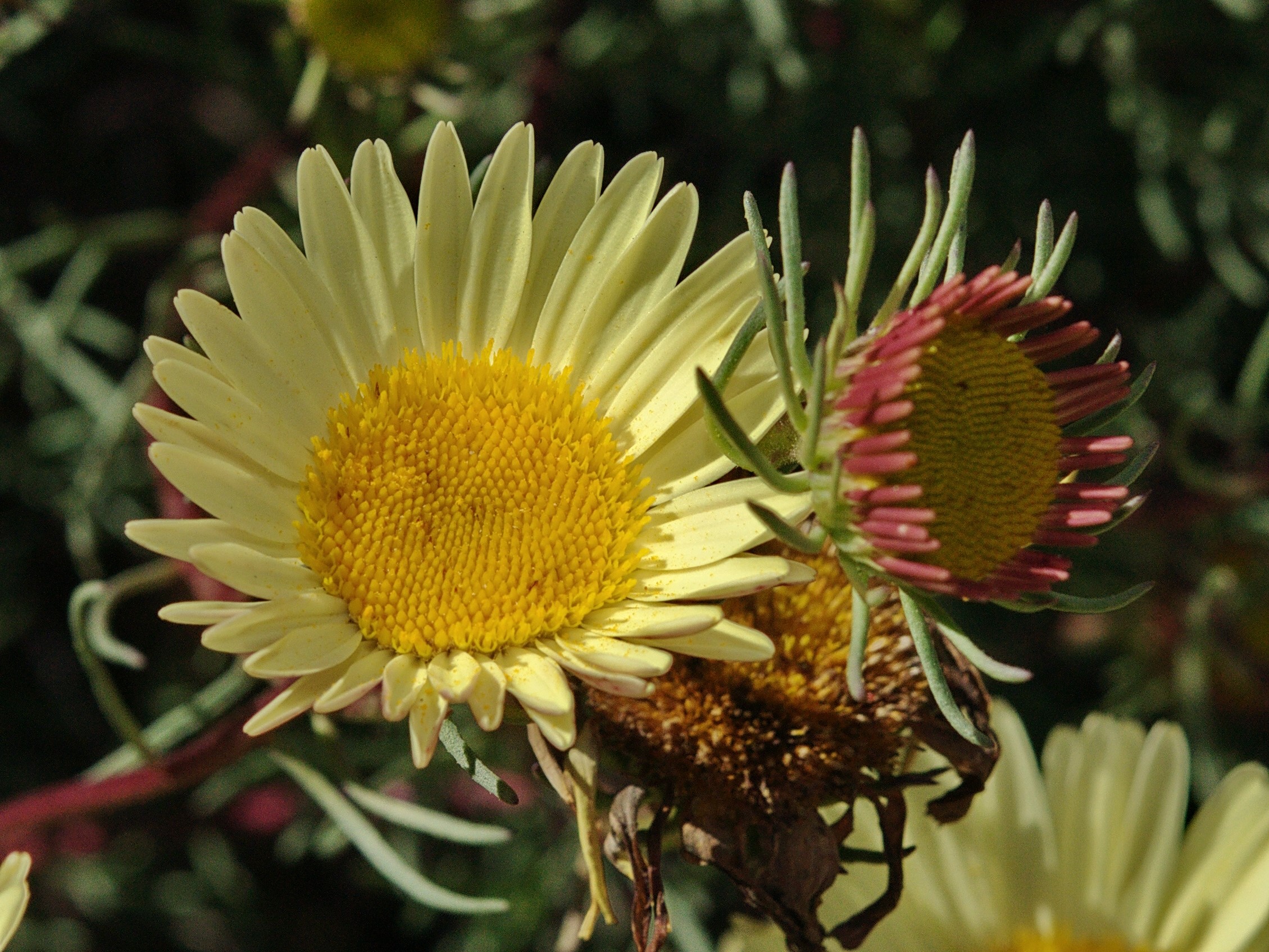
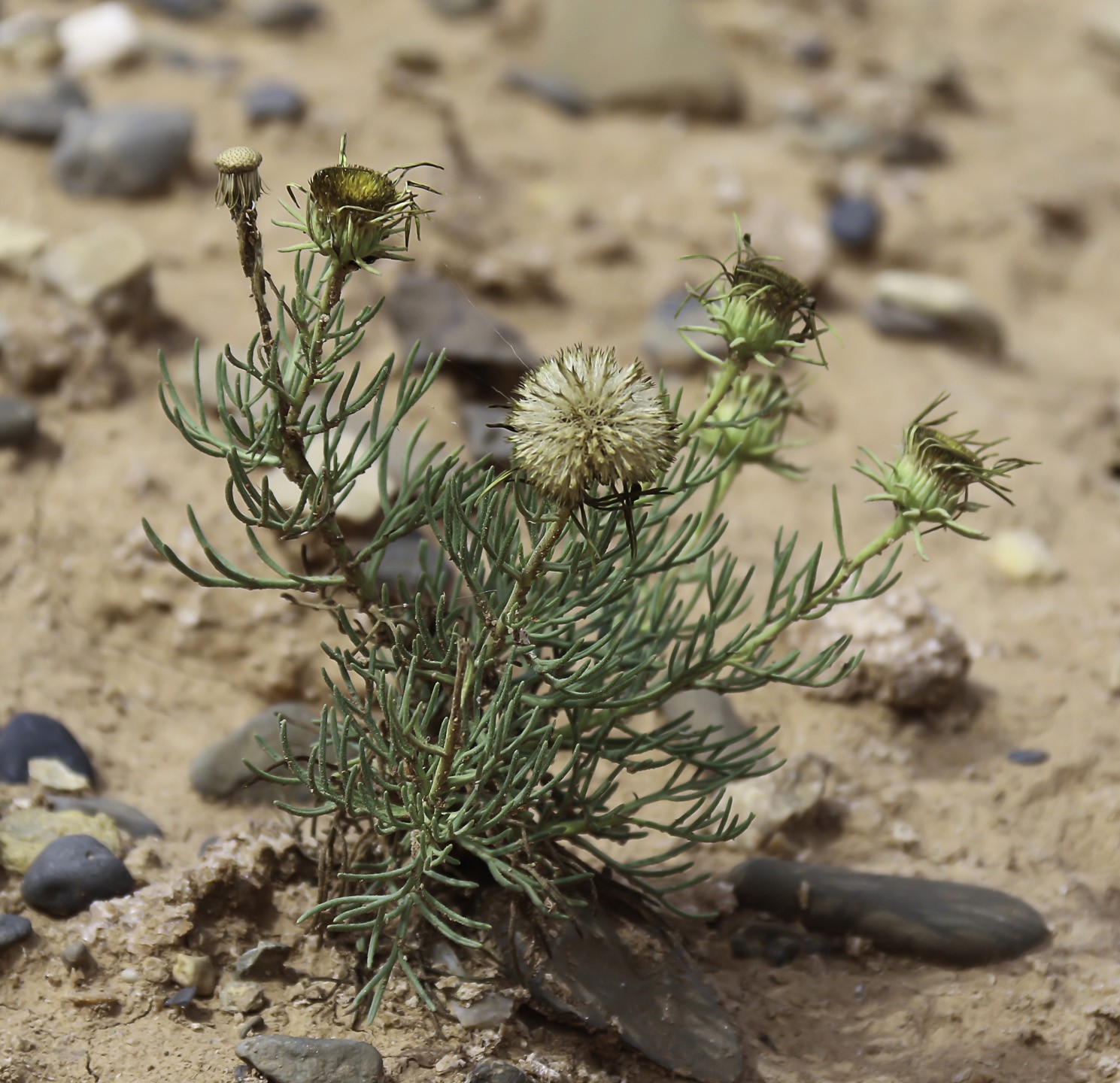
Perralderia coronopifolia Coss.
Ara.: Lahiet et tis. Tam.: Auarhad, thafs, ttafès, ttafus, tafr’a.
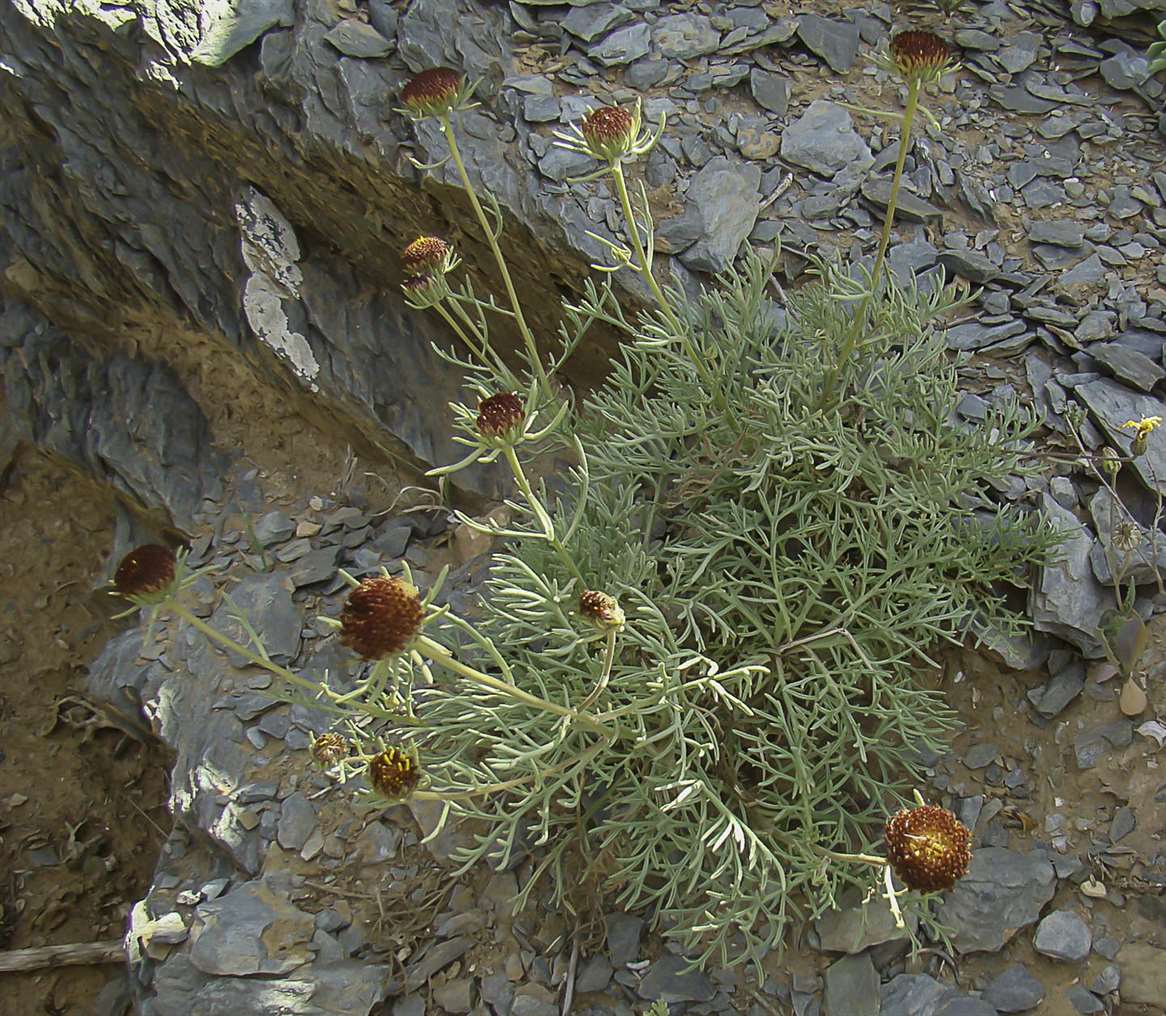
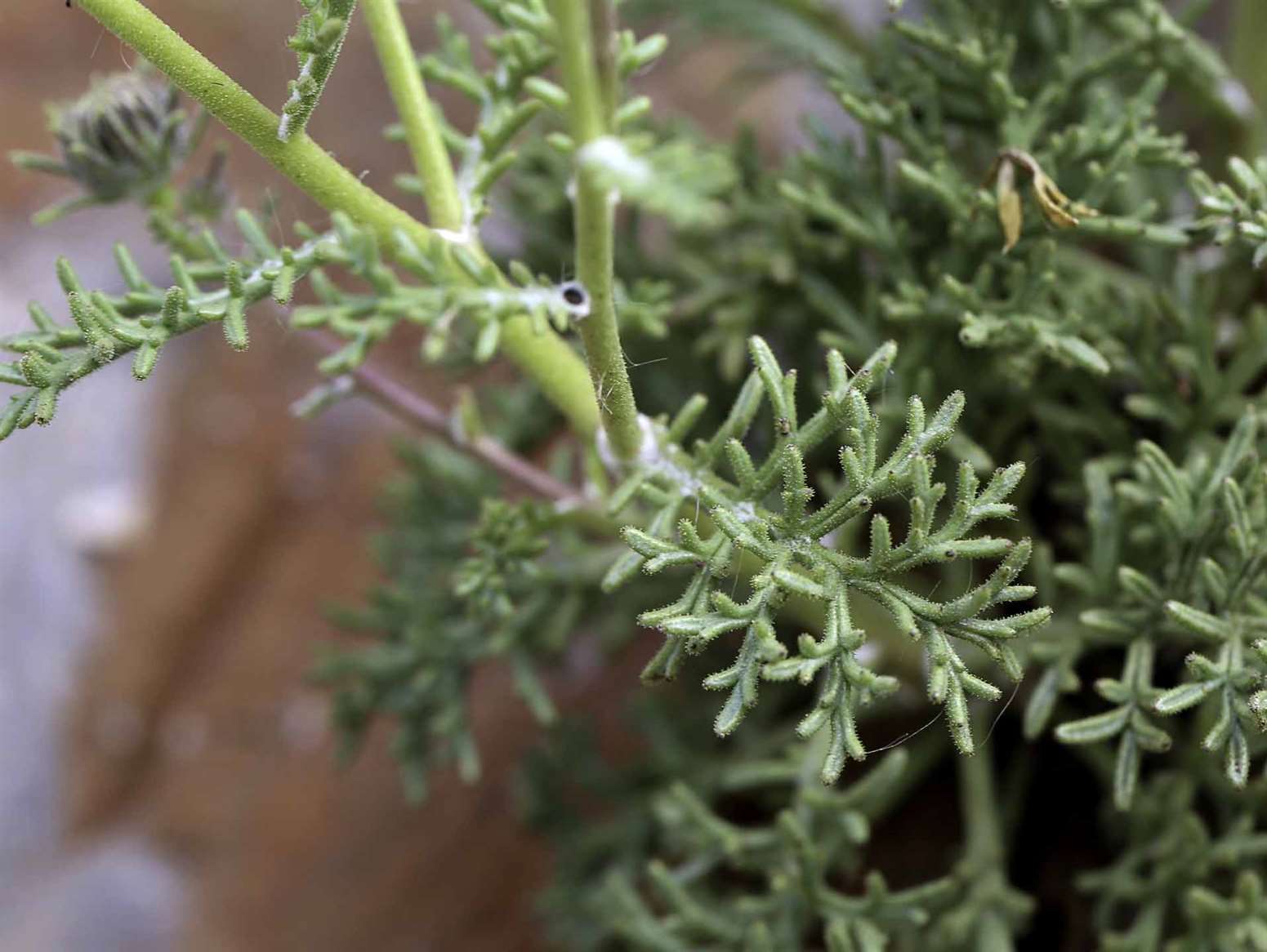
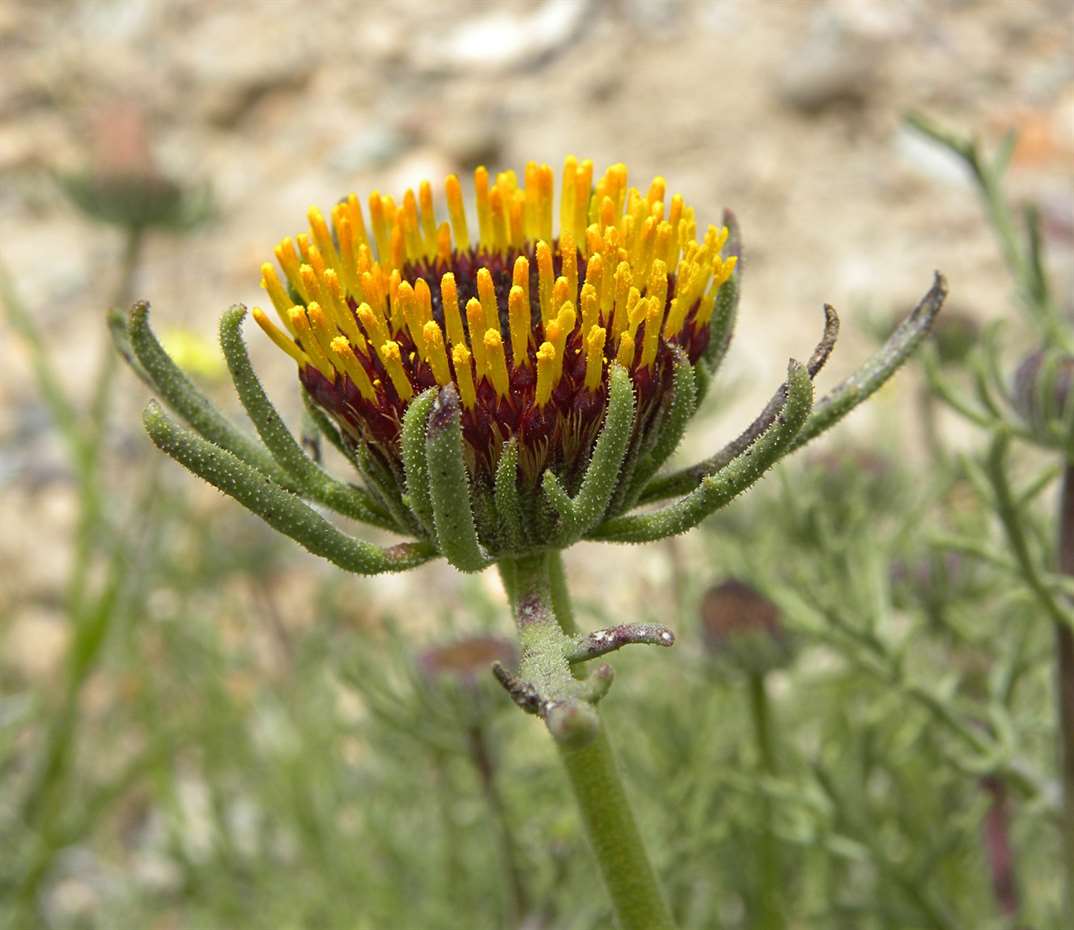
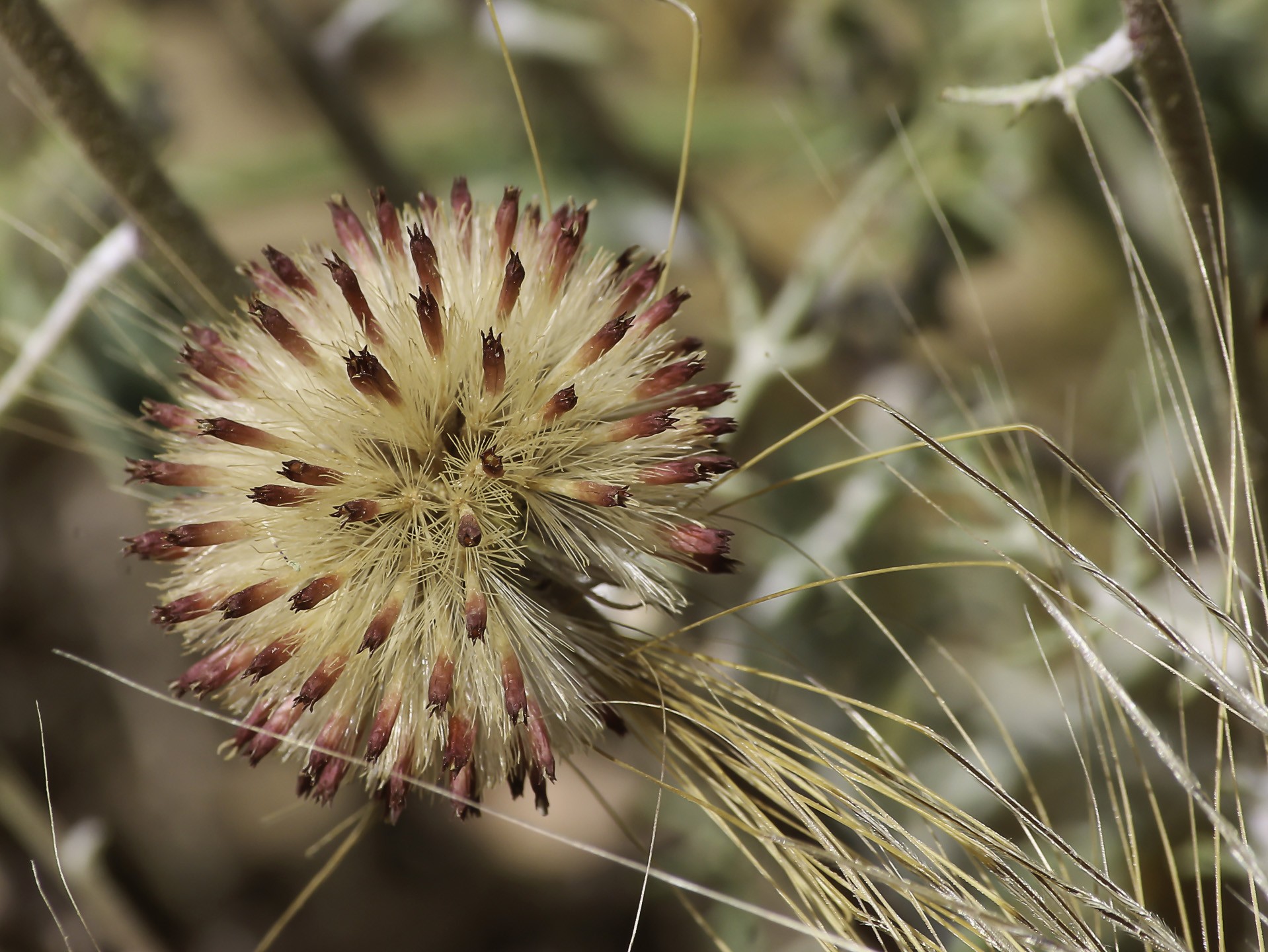
Subshrub pubescent-glandular, up to 50 cm in height. Leaves pinnatisect or bipinnatisect, glabrous or glandular-pubescent, with linear and entire divisions. Capitula solitary, 2.5-3.5 cm in diameter, with all flowers in disc florets and hermaphrodite, yellow or purple and with purple corolla lobes. Involucre surrounded by some involucral leaves, linear, longer than the involucre and 1-2 rows of bracts, imbricate, linear, hairy, with laciniate apex. Achenes cylindrical, ± densely pubescent with hairs sometimes short and applied, and 10 longitudinal shallow ribs, with a double pappus formed by an inner row of scabrid setae and an outer row of much shorter setae than the inner ones.
Flowering:
March to July.
Fruiting:
April to August.
Habitat:
Rocky outcrops and scree in arid and desert areas.
Distribution:
Central-Atlantic Morocco, High Atlas, Anti-Atlas, Central and Western Sahara.
Observations:
There are 2 subspecies. Subsp. coronopifolia, with leaves usually pinnatisect and yellow flowers, is endemic to desert and arid areas of Algeria and Morocco. Subsp. purpurascens
(Batt.) Maire, with bipinnatisect leaves and purple flowers, is a taxon typical of western Sahara.
There are a further 2 North African species that belong to this genus: P. paui Font Quer [Fontqueria paui (Font Quer) Maire] is a subshrub with a woody base up to 40 cm in height, with only glandular hairs laxly arranged, and capitula usually with yellow ray florets (with 3 lobes) on the periphery and disc florets in the centre; it is endemic to Morocco. P. garamantum Asch. is a subshrub up to 80 cm in height, which, as P. coronopifolia, is ± densely pubescent-glandular but with flowers as in P. paui, with ray florets (with 3 lobes) on the periphery and disc florets in the centre; it is endemic to Libya (Tripolitania).
Conservation status:
P. coronopifolia can become locally common, but P. paui and P garamantum are rarer and with smaller distribution areas. Currently, it has not been assessed at a global level in the IUCN Red List of Threatened Species. In the Livre Rouge de la flore vasculaire du Maroc (Fennane, 2021) P. coronopifolia has been considered as Least Concern (LC) and P. paui as Near Threatened (NT).