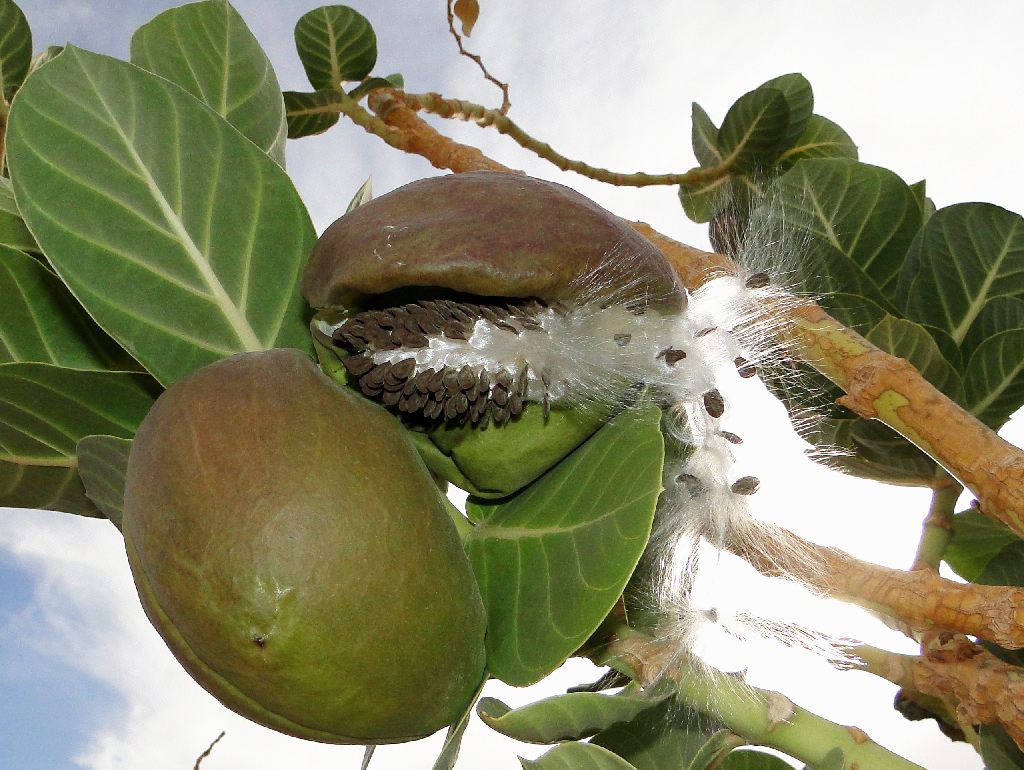
Calotropis procera (Aiton) W.T. Aiton
Asclepias procera Aiton.
Eng.: Giant milkweed, french cotton, mudar plant. Spa.: Algodón de seda, bomba. Fre.: Pommier de Sodome. Ara.: Krenka, krinka, krunka, karuka, uhechar, oshar, oshaar, branbakh. Tam.:/Tamahaq: Teça, taça, torcha, turha, torha, turza, turdja, turje, kaïs, tintafia.
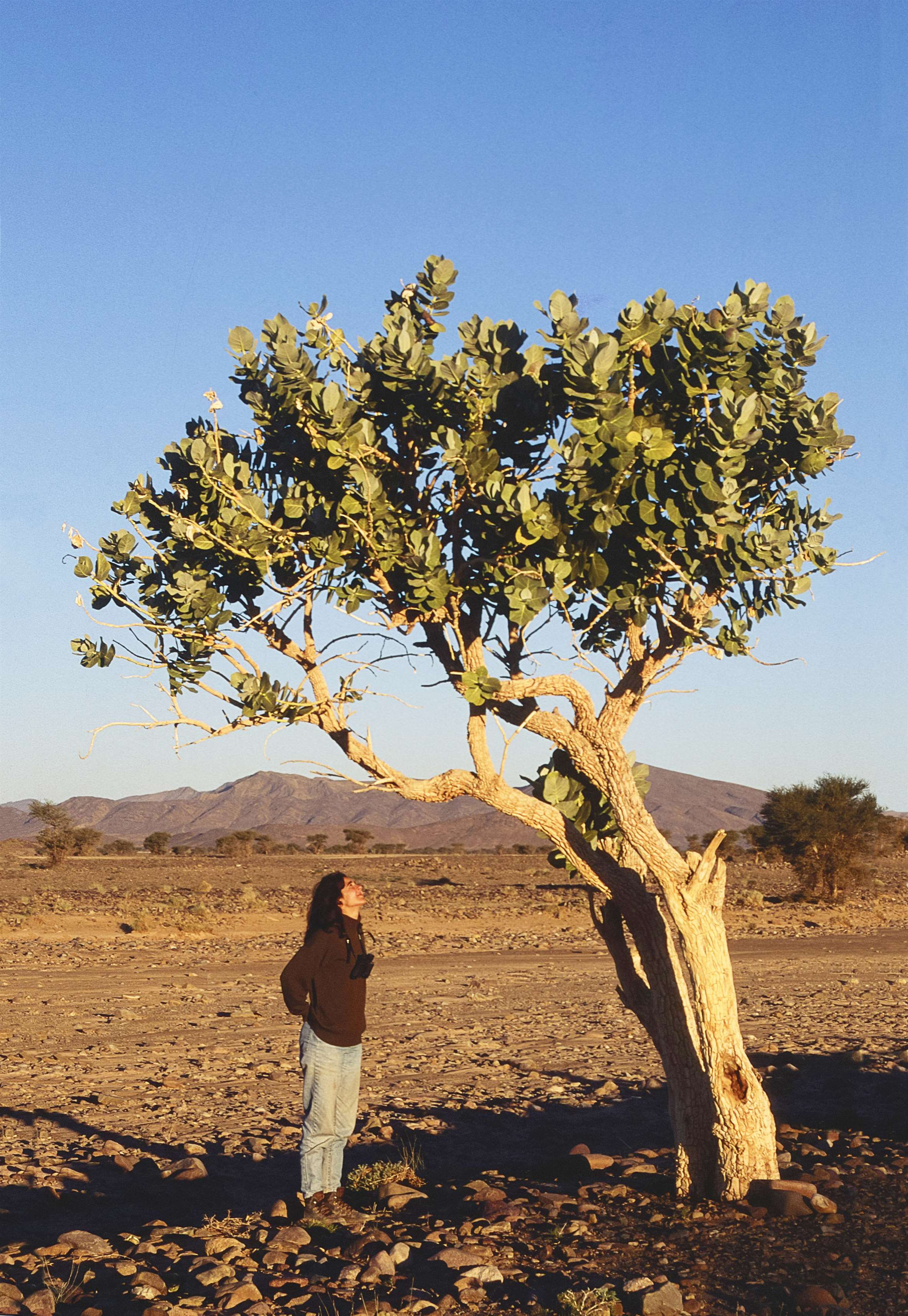
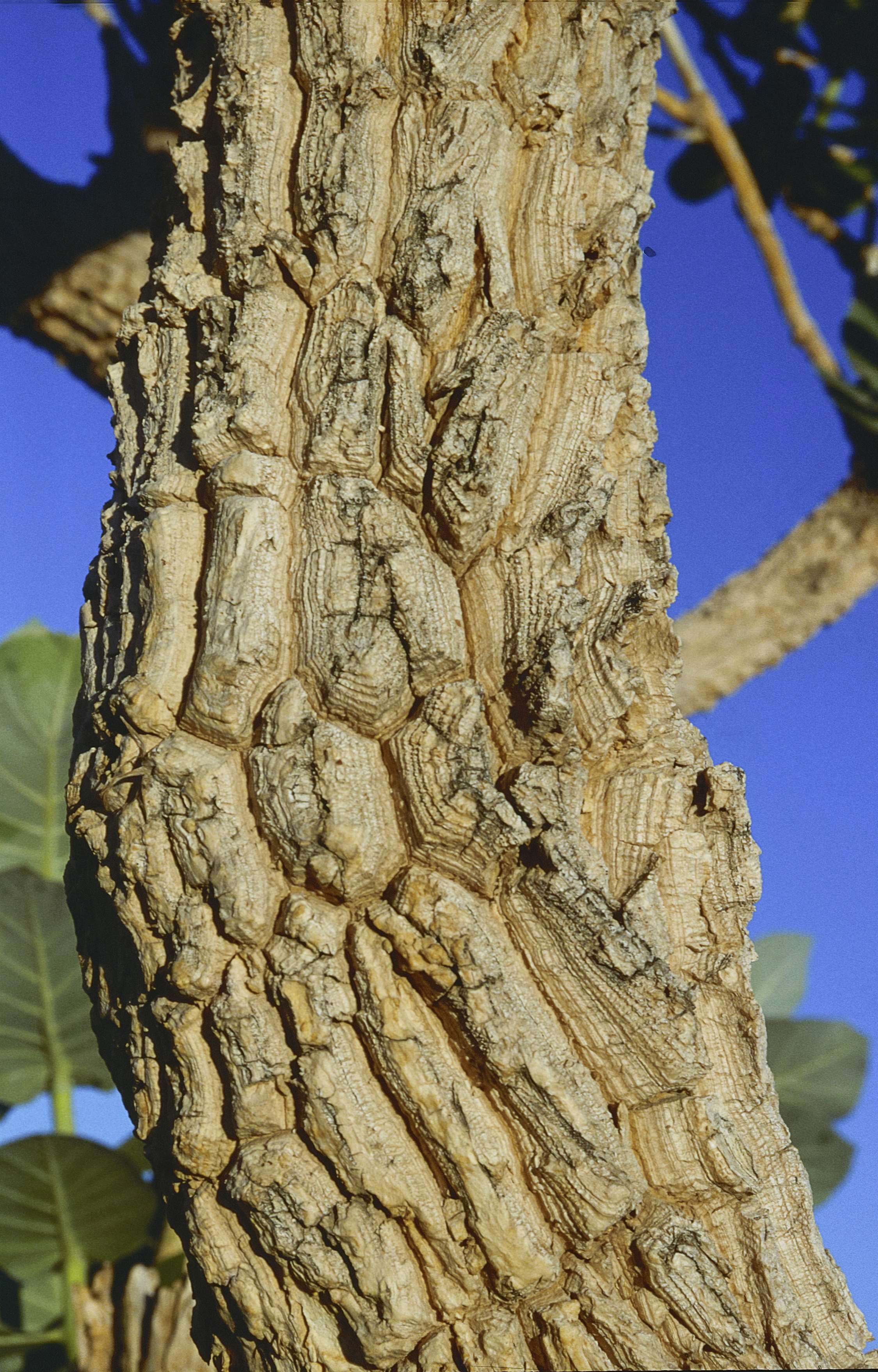
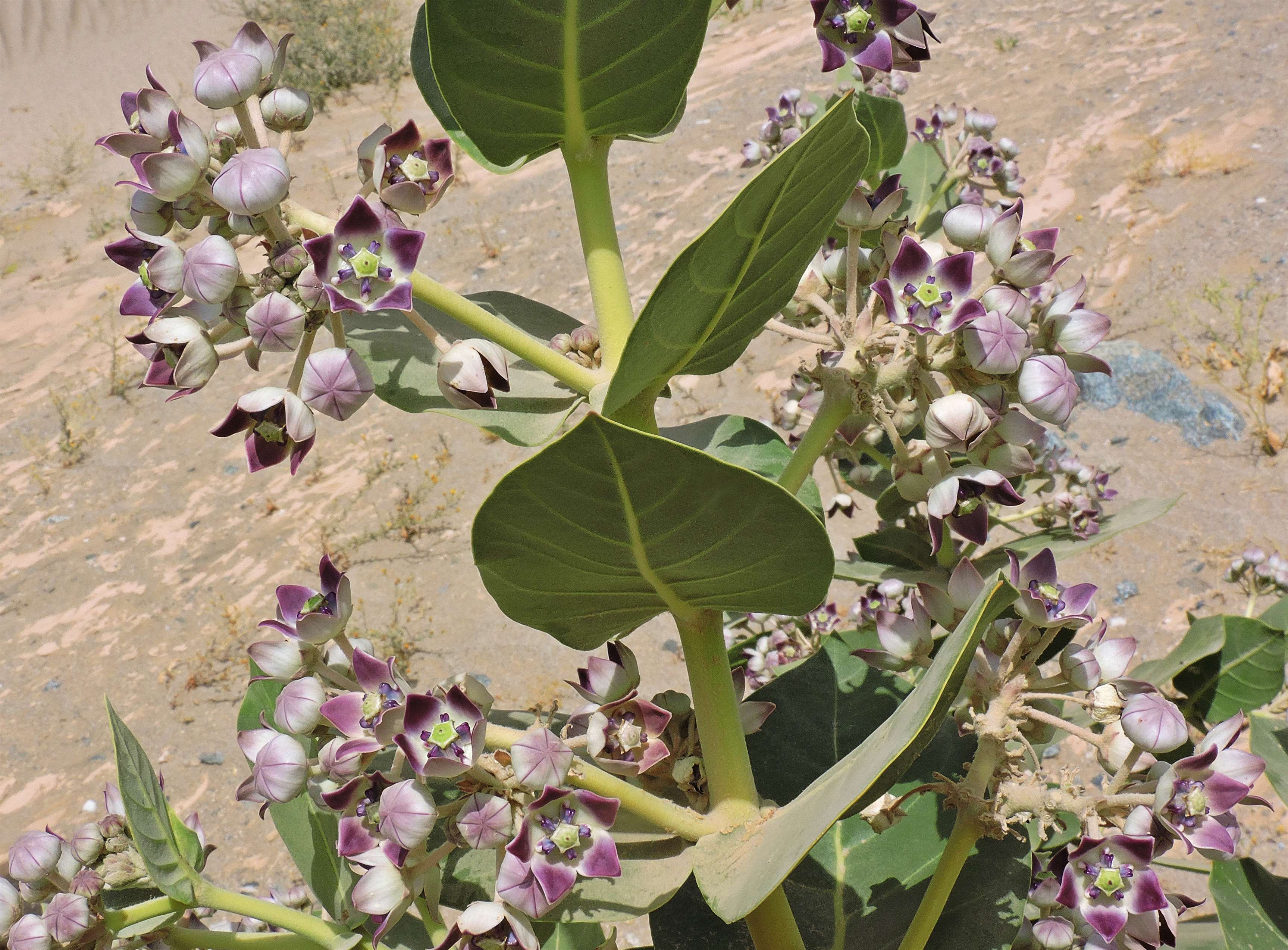
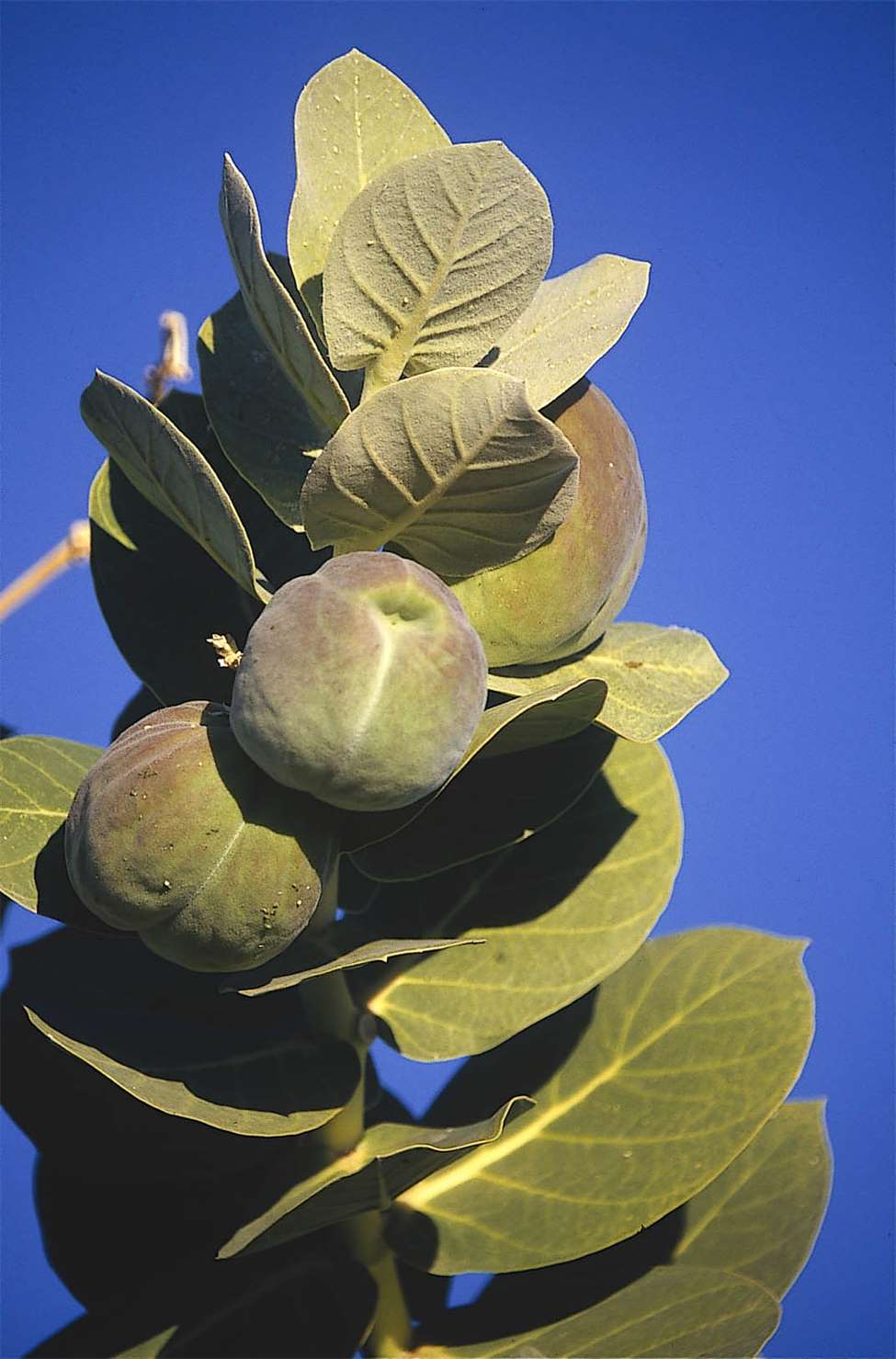
Small tree, evergreen, hermaphrodite, up to 4(6) m in height, although frequently it has a shrubby bearing. Old stems with corky fissured and suberose bark, reminiscent of the bark of the oak, but whitish. It produces a very abundant milky latex. Young branches white-tomentose, covered with a dense tomentum of white hairs. Leaves opposite, almost sessile, entire margin and auriculate base, almost amplexicaule, leaf blade 9-15(20) × 5.5-10(15) cm, from oblong-obovate to broadly obovate and apex ± rounded or acute, generally acuminate; covered with cottony tomentum when young, then glabrescent, deep green on the upper side, with marked venation, puberulent-pubescent and greenish-whitish on the underside. Inflorescence in dense axillary cymes. Calyx divided to the base into 5 small sepals 4-6 × 3-4 mm, ovate, acute, whitish-pubescent on the outside. Corolla 2-2.5 cm wide, with 5 ovate-triangular petals, white on the outside, and on the inside white at the base and purple in the upper half. Nectariferous disc characteristically pentagonal, whitish-yellowish, with 5 ± purple stamens borne on its side. Fruit a large follicle (8-14 × 09.06 cm), subglobose, obliquely ovoid, with rounded apex, green, spongy, soft. Seeds (6-8 × 5-6 mm) ovoid, ± flat and with a pappus.
Flowering:
Usually after rainfall.
Fruiting:
1-2 months after flowering, with plants bearing flowers and fruits almost simultaneously.
Habitat:
Stony or loamy-sandy plains, and in the drier areas especially in river depressions. From Saharan to semiarid bioclimate.
Distribution:
Fundamentally Saharo-Sindian, reaching some areas of the adjacent regions. Towards the E it reaches India, where, in the dry and mesophilic areas it becomes a common species. In North Africa this species is widely distributed throughout most of the Sahara, becoming locally common in some areas of the Atlantic Sahara; also common in the Sahel, and rarer in the northern Sahara. Introduced in some tropical regions (America, Australia).
Conservation status:
Common and widespread species. In the IUCN Red List of Threatened Species it is listed as Least Concern (LC) at global level (Harvey-Brown, 2022). In the Livre Rouge de la flore vasculaire du Maroc (Fennane, 2021) it has been considered as Near Threatened (NT). In the updated red list of Egypt (Shaltout & Bedair, 2023) it has been considered as Least Concern (LC).