Erica umbellata L.
Eng.: Dwarf Spanish heath. Spa.: Brezo, brecina. Fre.: Bruyère.
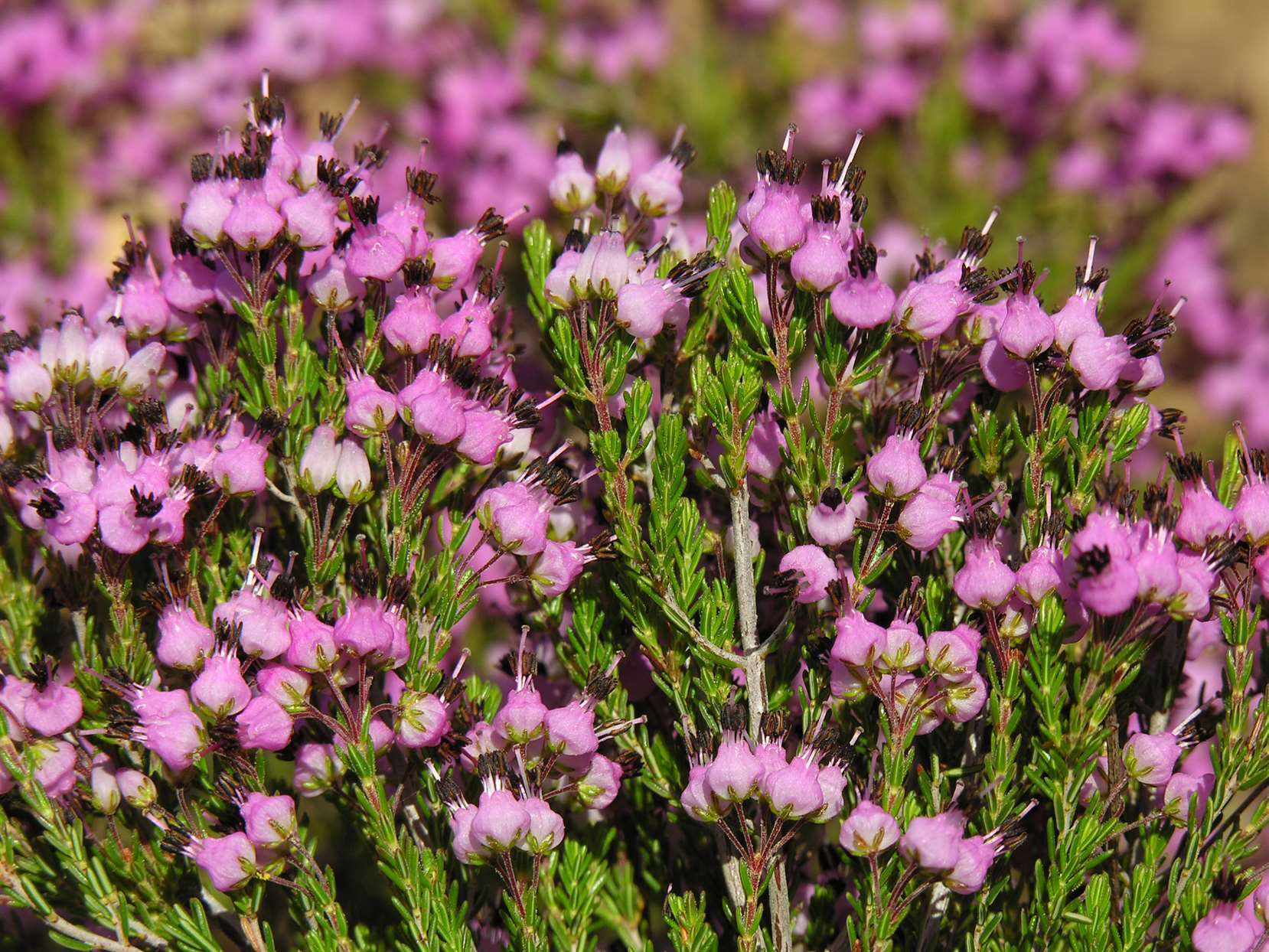
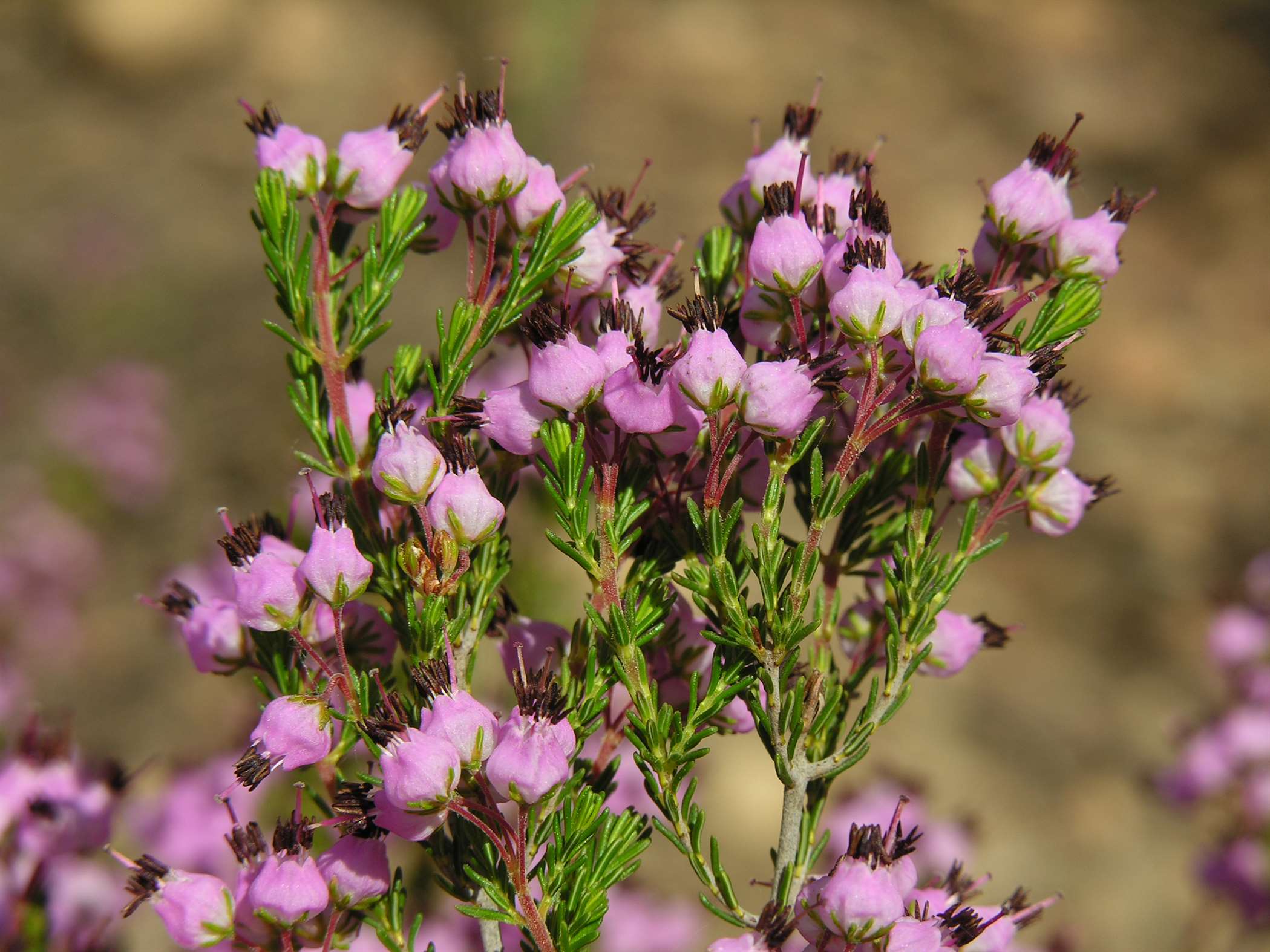
Shrub or subshrub, evergreen, hermaphrodite, up to 1 m in height, highly ramose, erect. Branches usually erect, with brownish-greyish or reddish-brown bark. Branchlets greenish or reddish, villous-tomentose. Leaves in whorls of 3 (1.5-5 × 0.4-0.7 cm), clearly petiolate, linear-lanceolate, ending in an obtuse tip, ± villous on the upper side —at least in when young—, margin very revolute that hides the underside completely. Inflorescences terminal, umbelliform, with 3-6 flowers, without an involucre of basal bracteoles that is present in other species; pedicel of approximately the same length as the corolla, pubescent. Sepals form oblong to lanceolate (1.5-2 mm), green and villous. Corolla deep pink or purple (3-6 mm), very characteristic, globose, not subtubular, very narrow at the top, with lobes not recurved. Anthers exserted, without any appendages. Fruit a capsule, from subglobose to pyramidal, glabrous and dehiscing in 4 valves. Seeds very small (0.4-0.6 mm), ellipsoid, yellowish-brown, with rugose or verrucose surface.
Flowering:
February to June.
Fruiting:
April to August.
Habitat:
Calcifuge species that grows always in siliceous soils, both rocky and sandy, in humid and subhumid bioclimate, in ± mild winters, on thermomediterranean to supramediterranean floors.
Distribution:
Ibero-Maghrebi endemism. In North Africa it is only present in the central-western Rif and subcoastal Atlantic hills of northern Gharb (Morocco).
Conservation status:
Rare species, with a small distribution area. Currently, it has not been assessed at a global level in the IUCN Red List of Threatened Species. In the Livre Rouge de la flore vasculaire du Maroc (Fennane, 2021) it has been considered as Near Threatened (NT).