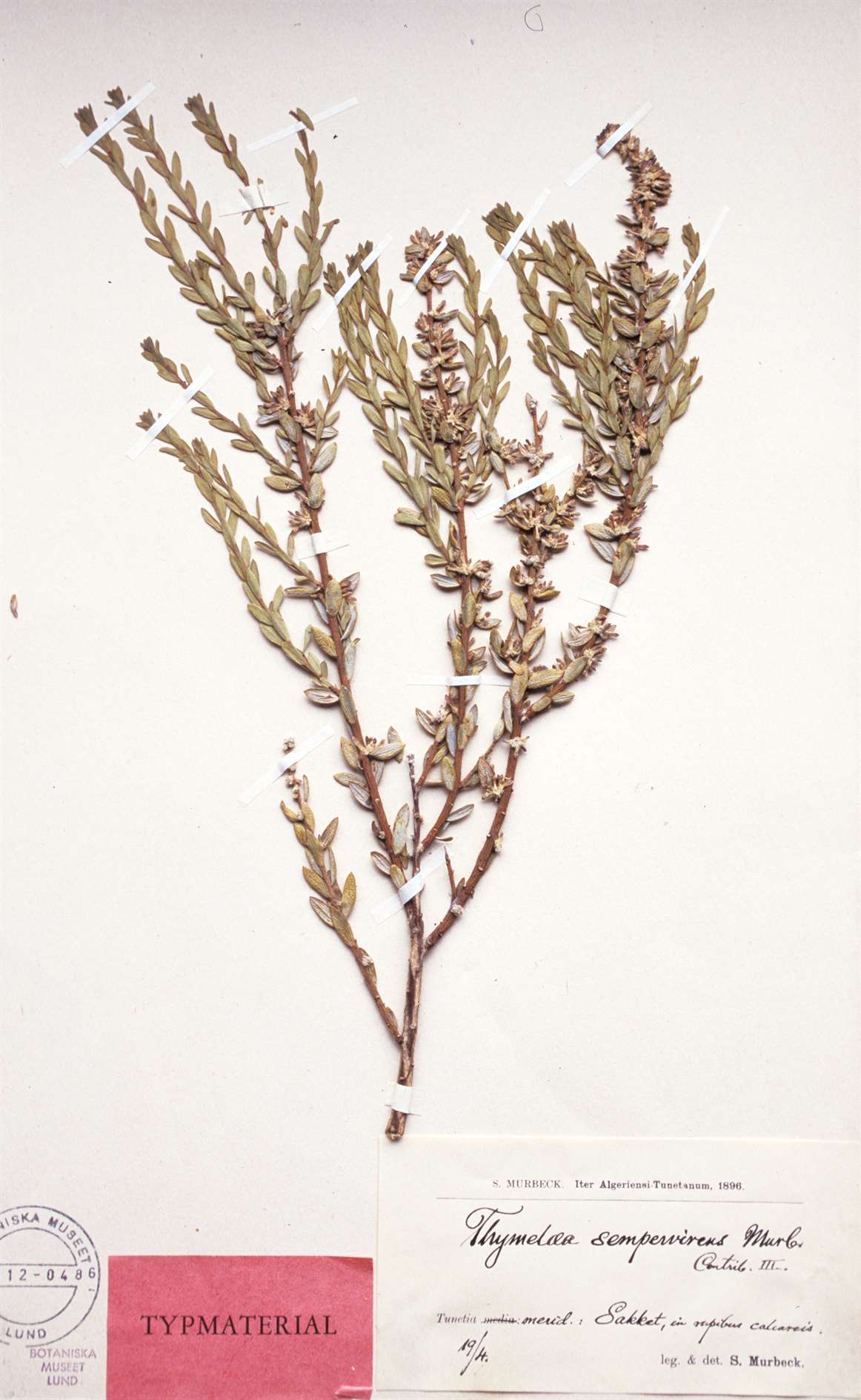
Thymelaea sempervirens Murb.
Subshrub up to 50 cm in height, erect, monoecious (?). Stems glabrous. Leaves not imbricated, ± patent, 9-13 × 3.5-5 mm, elliptic-lanceolate, acute or subacute, flat, sessile, ± thick, coriaceous, persistent, glabrous. Inflorescences in axillary glomeruli, with 7-20 flowers and 6-10 bracts 1 × 1.2 mm, ovate, obtuse, pubescent. Flowers unisexual, 6-7.5 mm, ± tubular, yellow-purple; hypanthium appressed-pubescent; sepals 1.5-2 mm, ovate, obtuse. Ovary pubescent. Fruit and seeds unknown.
Flowering:
April-?.
Fruiting:
No data for this region
Habitat:
Calcareous rocky outcrops, in semiarid environment, around 350 m in altitude.
Distribution:
Endemic to Tunisia. Ksar Sakket (E of Gafsa) and Jebel Bu Hedma.
Observations:
Only the type material is known for this species, collected in 1899 near Ksar Sakket [Murbeck 1899. Acta Univ. Lund. 35(3): 14]. In 1971, P.H. Davis unsuccessfully sought this species in the locality (Tan 1980. Notes Roy. Bot. Gard. Edinburgh 38: 215). More recently, it was cited in the Bu Hedma National Park (Schoenenberger Mission 1987; Noumi 2010. Acacia tortilis (Forssk.) Hayne subsp. raddiana (Savi) Brenan en Tunisie pré-saharienne: structure du peuplement, réponses et effets biologiques et environnementaux. Thése. Univ. de Sfax-Univ. de Bordeaux 1).
According to rDNA phylogenetic studies Th. tartonraira and Th. putorioides are its more closely related species.
Conservation status:
Very rare species with a small distribution area. Currently, it has not been assessed at a global level in the IUCN Red List of Threatened Species.