Helianthemum syriacum (Jacq.) Dum. Cours.
H. racemosum auct., H. lavandulifolium Desf.
Spa.: Té moro, té del campo, estepa amarilla, romero blanco. Fre.: Hélianthème à feuilles de lavande.
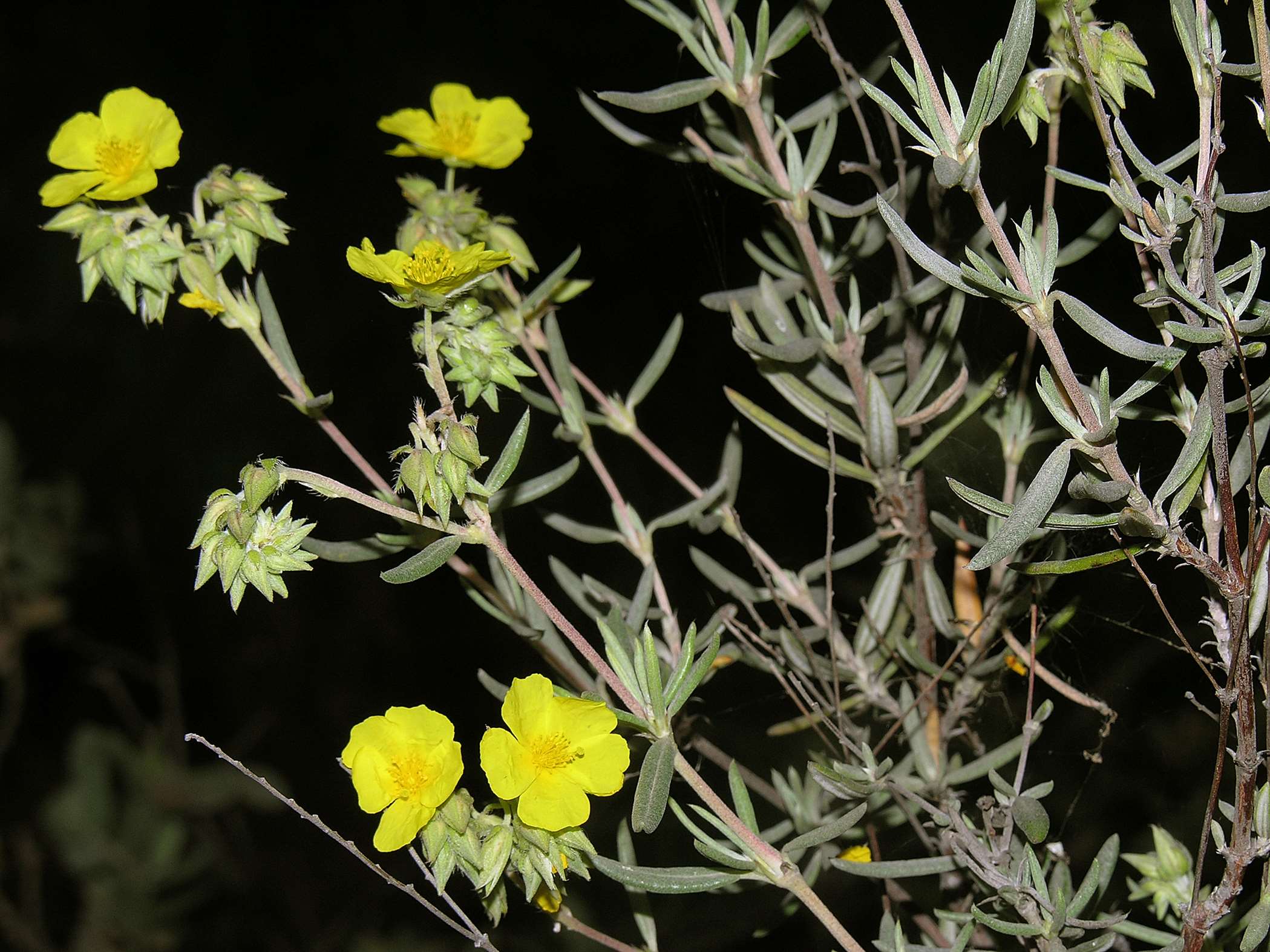
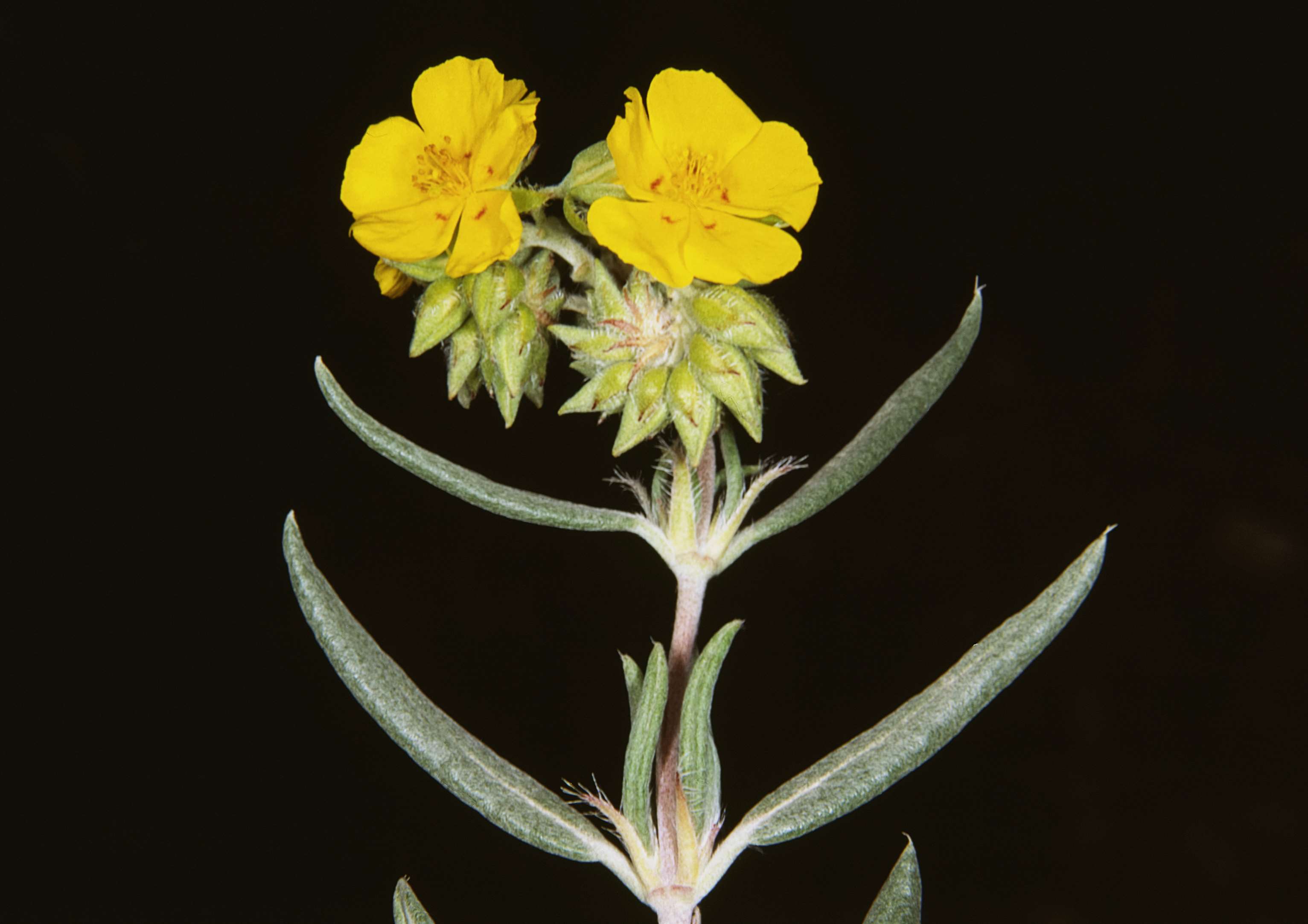
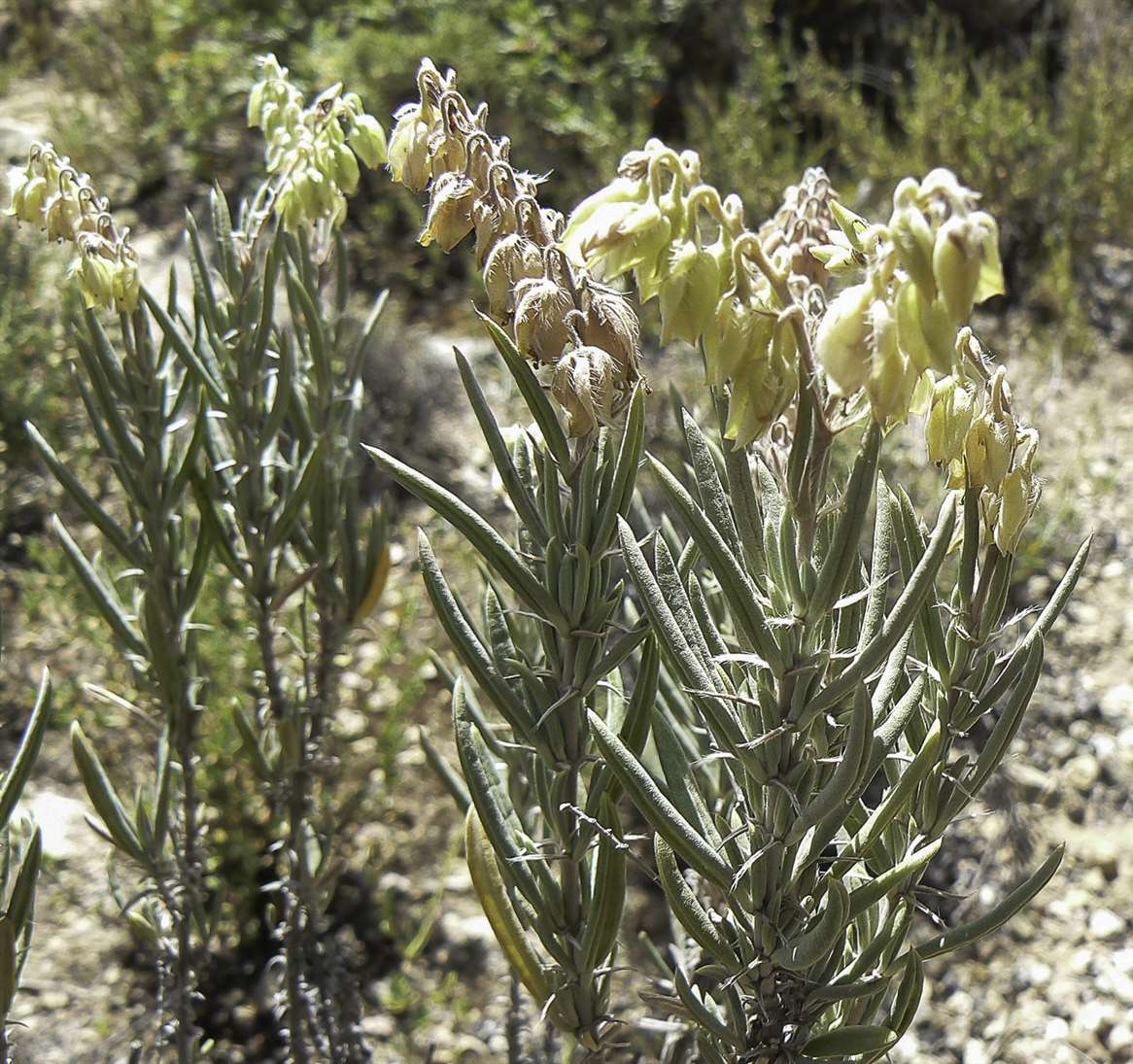
Evergreen subshrub, hermaphrodite, up to 0.8(1.2) m in height, erect, rarely stunted, very branched, stems and older branches distinctly woody, with brownish bark. Young branchlets pubescent, reddish-brown, greenish-reddish or red, with stellate hairs. Leaves opposite (0.8-5 × 0.1-0.8 cm), linear-lanceolate, ending in a very acute tip (mucro), attenuated at the base on a short petiole; margin usually revolute, greenish-grey on the upper side and greenish-whitish and tomentose on the underside. Stipules from triangular to ovate, usually longer than the petiole. Inflorescence corymbiform, composed of 3-5 branches with 8-30 flowers each. Calyx with 5 sepals; outer 2 sepals lanceolate, minute (1.5-4 mm), inner 3 sepals larger (5-9 mm), ovate or ovate-lanceolate, acute, with tomentum of stellate hairs and 2 slightly marked ribs. Petals 5, obovate, yellow, without dark patch at the base, similar in length to the inner sepals. Fruit a capsule from ovoid to ellipsoid, with 3 short edges, 3-4 mm, dehiscent in 3 valves. Seeds 3-6, slightly over 1 mm and dark in colour. 2n = 20; n = 10.
Flowering:
March to August.
Fruiting:
May to September. It is not uncommon to see flowering outside of these dates, however complete fruiting is rarer outside of the summer season.
Habitat:
Thickets and other plant formations on alkaline, calcareous, marly, dolomitic and sandy terrains. Thermophilic species, that tolerates heat and drought well; however, frosts make it disappear. For this reason, its altitudinal distribution is from sea level to about 1,000 m in altitude (up to 1,200 in the sunniest mountains in the south).
Distribution:
Western Mediterranean. In North Africa it is a relatively common species, distributed throughout almost the entire Mediterranean area from Morocco to Libya.
Conservation status:
A fairly rare species, but widely distributed. Currently, it has not been assessed at a global level in the IUCN Red List of Threatened Species. In the Livre Rouge de la flore vasculaire du Maroc (Fennane, 2021) it has been considered as Least Concern (LC).