Halimium ocymoides (Lam.) Willk.
Cistus ocymoides Lam.
Eng.: Basil-leaved rockrose. Spa.: Jaguarzo blanco, monte blanco, alacayuela, pirula, quirola.
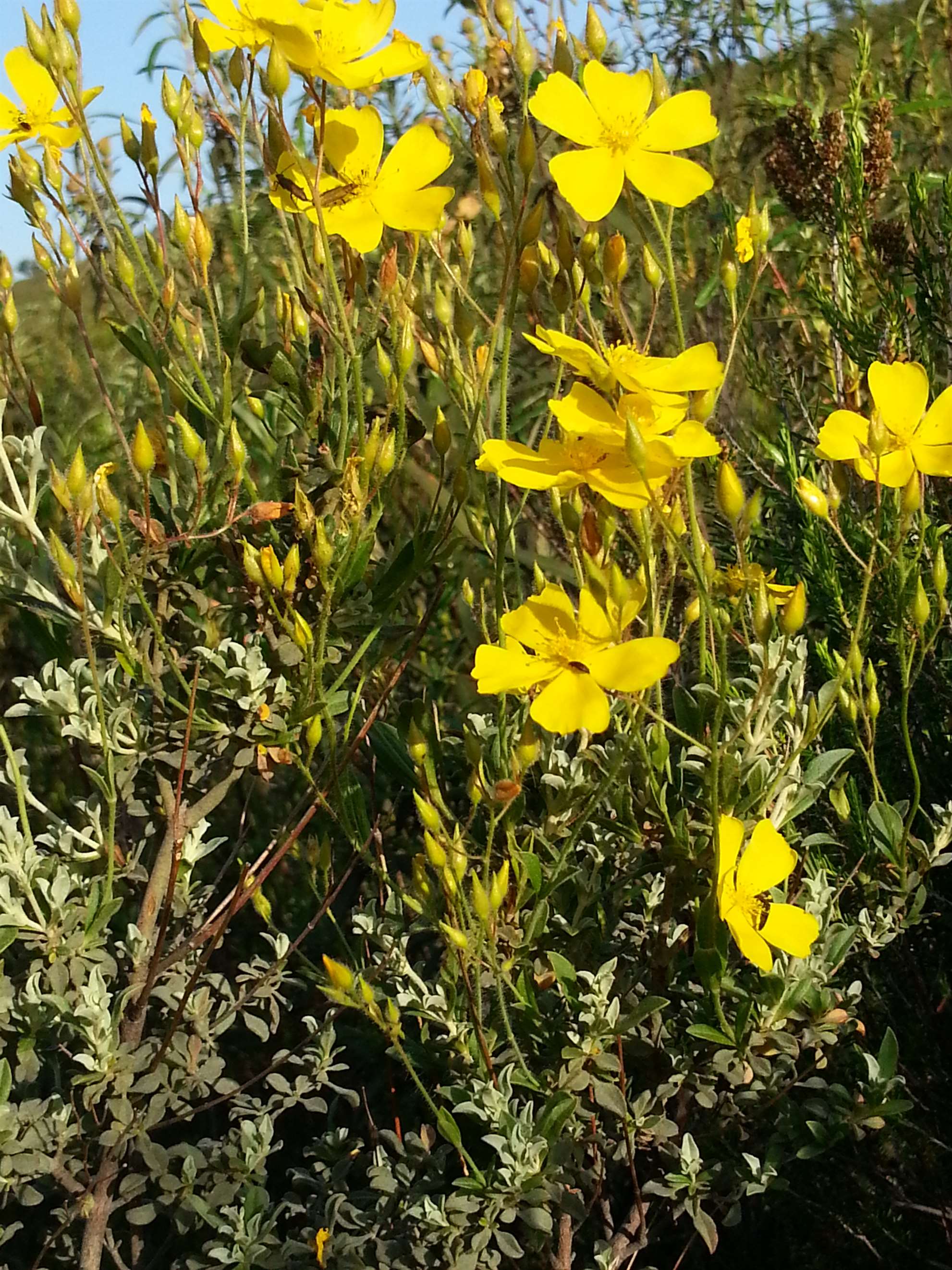
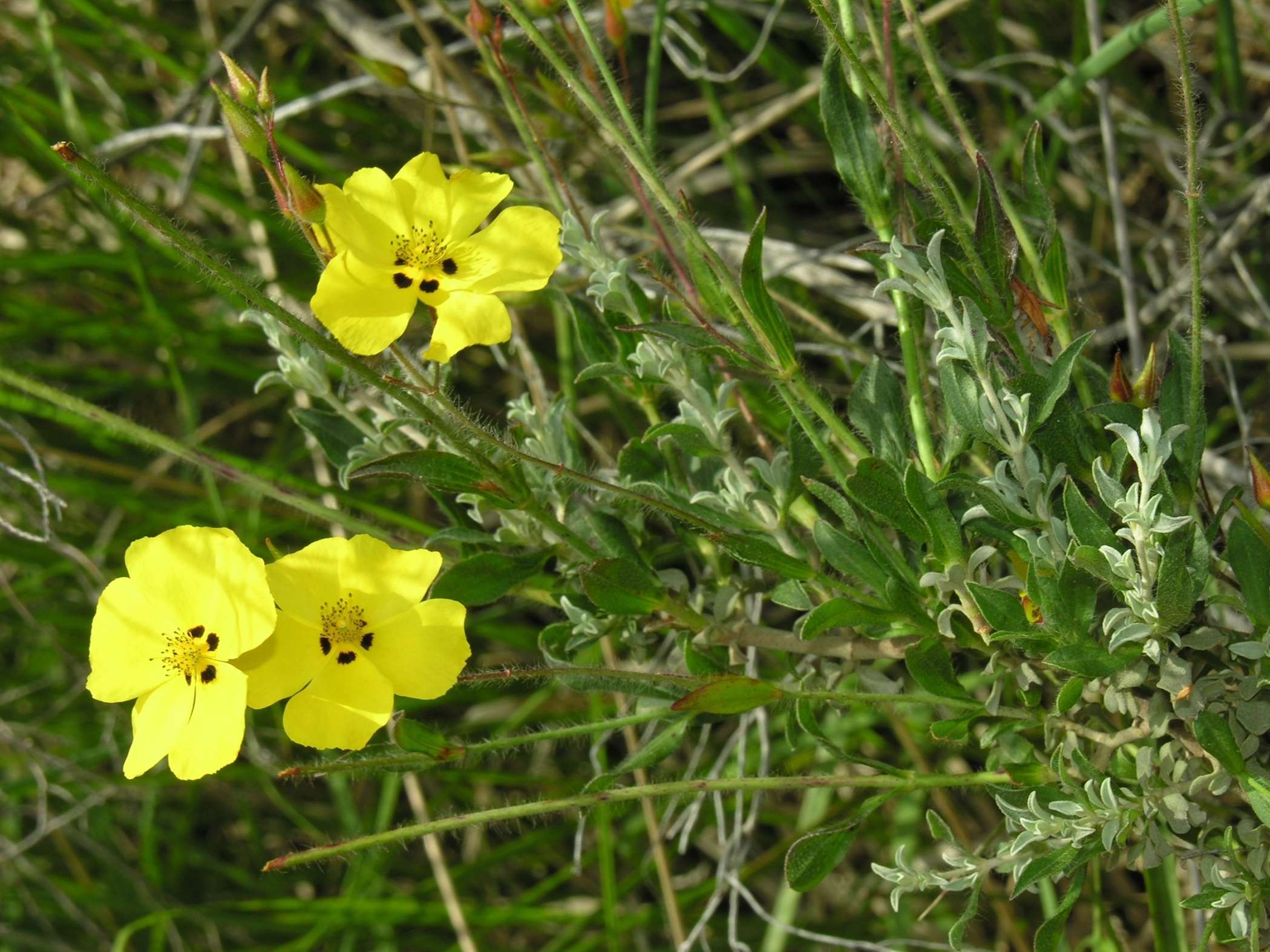
Evergreen shrub, hermaphrodite, up to 0.8(1) m in height, erect, highly ramose. Branches and branchlets greenish-silvery. Branchlets covered by a dense tomentum of stellate hairs. Leaves clearly dimorphic (a good characteristic for this species); in general all opposite, ± ovate, lanceolate or obovate, with entire, flat or slightly undulate margin; leaves of sterile branches (usually the basal branches) 0.2-1.5 × 0.2-0.75 cm, shortly petiolate, with clearly marked midrib on the underside, greyish-whitish on both sides because they are covered by a dense tomentum of stellate, persistent hairs; leaves of floriferous branches (usually the upper branches) larger (1-3.5 × 0.2-1 cm), sessile, with 3-5 veins clearly marked at the base, green because they are almost completely hairless, and promptly deciduous (they fall straight after flowering). Inflorescence in paniculiform cymes with few flowers; peduncle and pedicels very long and slender, with simple hairs, not stellate. Calyx with 3 sepals, 5-10 mm, ovate-lanceolate, sometimes hairless, but usually with simple hairs. Corolla with 5 petals, 10-18 mm, yellow, usually with a dark patch at the base. Fruit an ellipsoid capsule, 3.5-8 mm, dehiscent in 3 valves. Seeds c. 1 mm in diameter, polyhedral, with tuberculated surface, brown. 2n = 18.
Flowering:
March to August.
Fruiting:
May to September.
Habitat:
Forests and thickets (usually heathland), on very diverse siliceous terrains (stony, sandy, etc.), from sea level to almost 2,000 m in altitude. From dry to humid bioclimate; it can withstand drought and heat well, but not hard frosts.
Distribution:
Iberian-Moroccan endemic. In Morocco it is a very rare species, found only in the NW area (western Rif).
Conservation status:
A fairly rare species, that can become locally abundant. Currently, it has not been assessed at a global level in the IUCN Red List of Threatened Species. In the Livre Rouge de la flore vasculaire du Maroc (Fennane, 2021) it has been considered as Critically Endangered (CR).