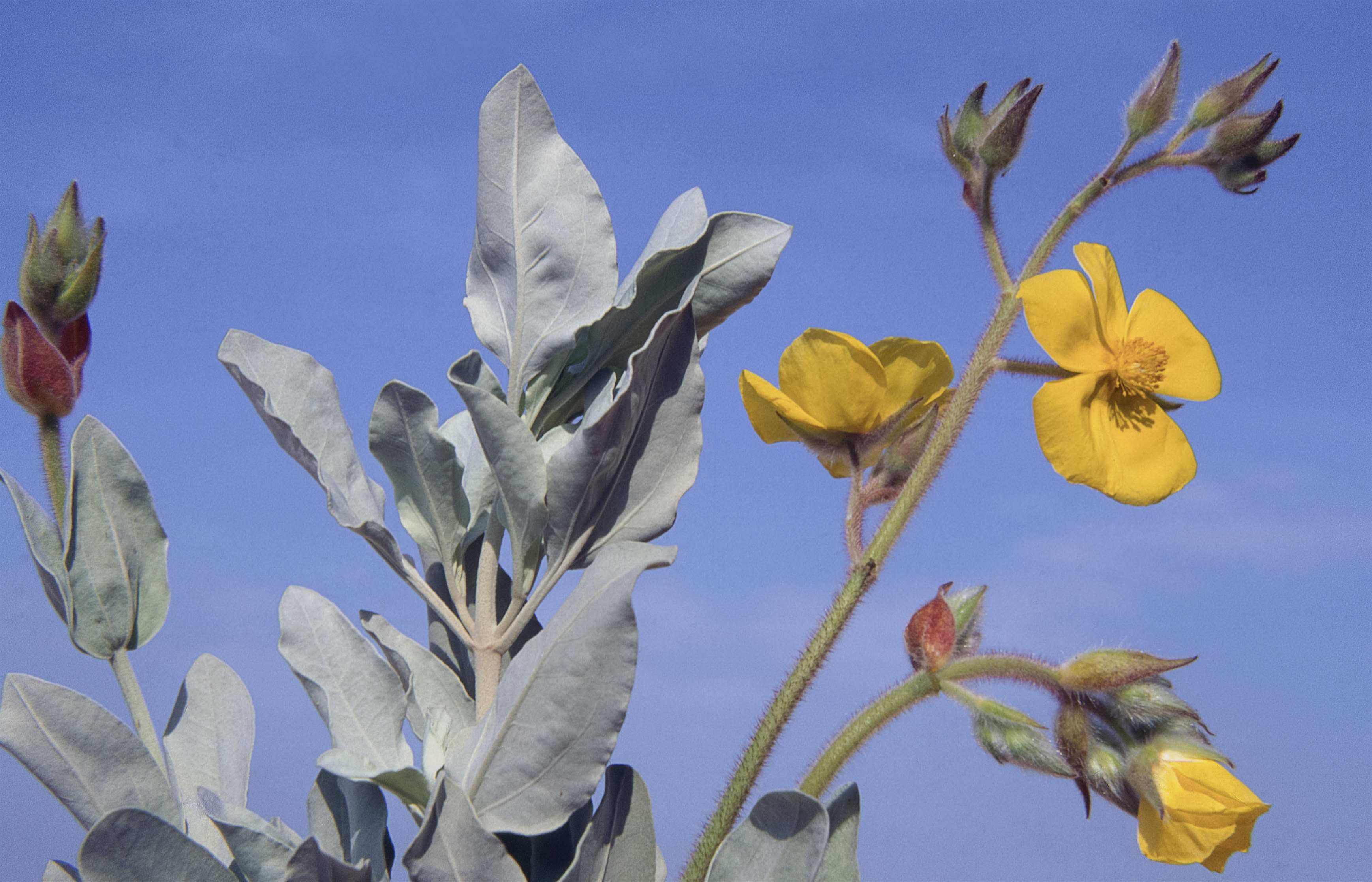
Halimium atriplicifolium (Lam.) Spach
Spa.: Estepa blanca, jara blanca, jaguarzo blanco. Fre.: Hélianthème à feuille d’arroche, ciste jaune.
Evergreen shrub, hermaphrodite, up to 1.5(1.75) m in height, erect, highly ramose, whitish-silvery in appearance. Branches, branchlets and leaves covered with a dense whitish tomentum of stellate, velvety hairs. Leaves opposite, large, 0.6-5.5 × 0.3-3.5 cm, ovate-rhomboid, ellipsoid or ovate-lanceolate, densely covered with small white hairs on both sides, with slightly undulate margin; leaves of fertile branches sessile, the rest clearly petiolate. Inflorescence in lax cymes, with long hirsute peduncles. Flores shortly pedicellate, in groups of 2-8. Calyx with 3 sepals, 10-20 mm long (up to 40 mm in subsp. macrocalycinum), ovate, longly acuminate, villous, with single unicellular hairs, solitary or fasciculate, mixed with other multicellular, reddish and glanduliferous hairs. Corolla with 5 petals, 10-25 mm long, yellow, promptly caducous, with a dark brown patch at the base. Fruit an ovoid capsule, 1-1.5 mm long, dehiscent in 3 valves, not visible at first because it is hidden inside the persistent calyx. Seeds 1-1.5 mm, polyhedral-convex, with tuberculated surface, yellowish-brown. 2n = 18.
Flowering:
March to August.
Fruiting:
May to September.
Habitat:
Clearings and edges of forests of pine, holm oak, cork oak and Portuguese oak, also in thickets formed from degradation of such forests; generally on silicate terrains (more rarely decarbonate). From dry to humid bioclimate, on mesomediterranean to supramediterranean floors.
Distribution:
Iberian-Moroccan endemic.
Observations:
Two subspecies have been described, subsp. atriplicifolium, with sepals up to 20 mm, which grows in central and southern Spain, and subsp. macrocalycinum (Pau) Greuter & Burdet, with larger sepals, up to 40 mm, endemic to NW Morocco.
Conservation status:
A fairly rare species, that can become locally abundant. Currently, it has not been assessed at a global level in the IUCN Red List of Threatened Species. In the Livre Rouge de la flore vasculaire du Maroc (Fennane, 2021) it has been considered as Near Threatened (NT).