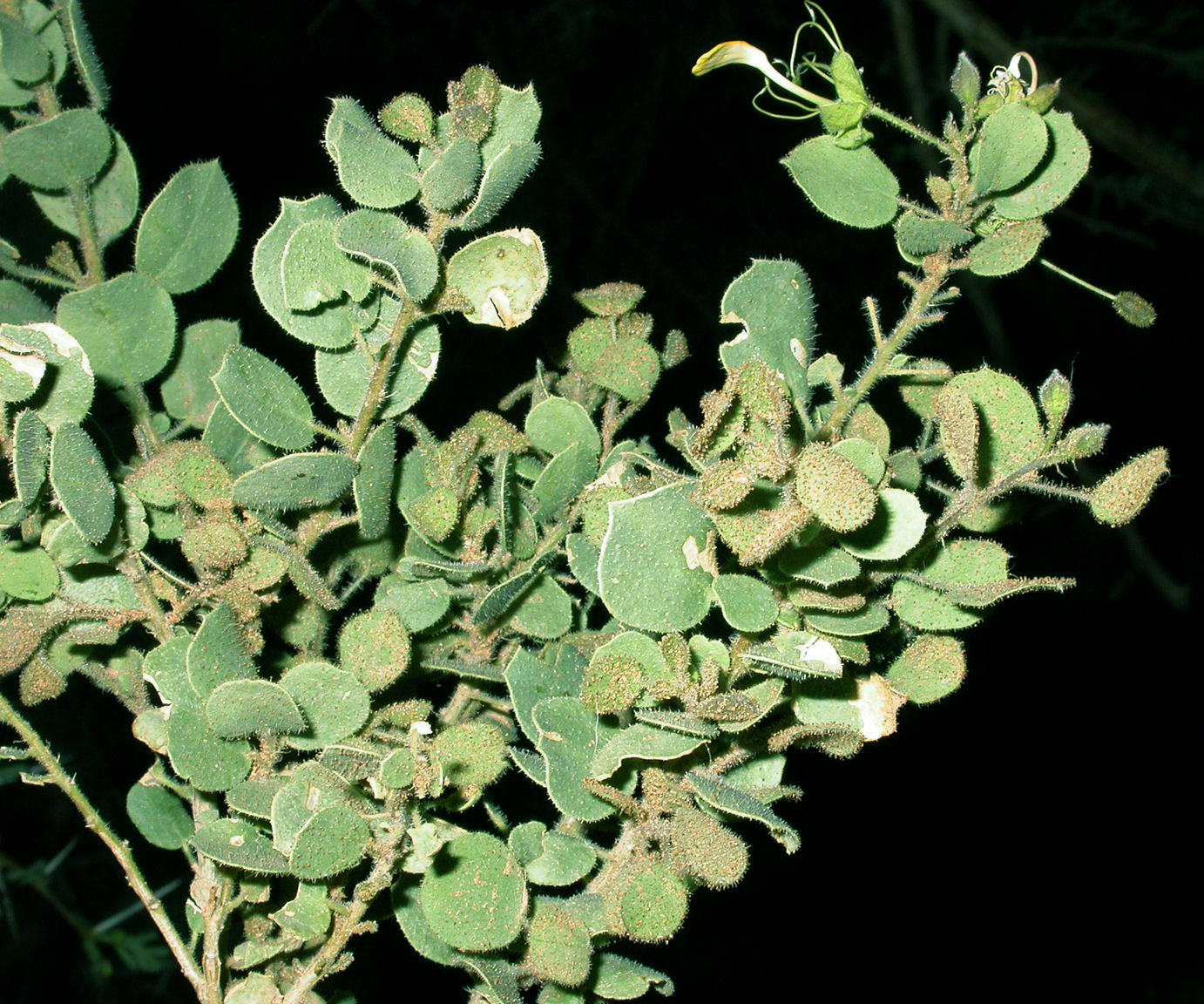
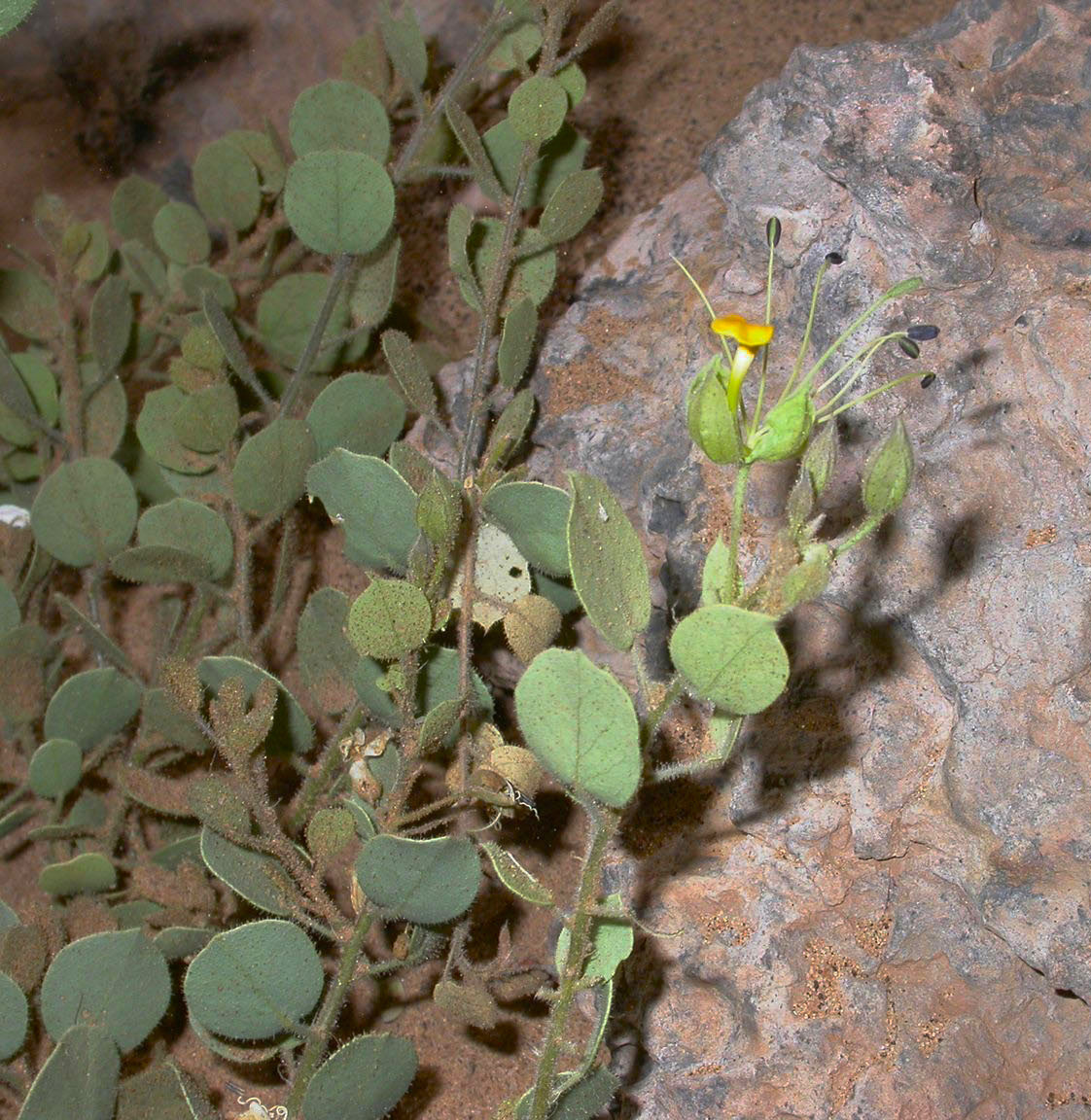
Cadaba glandulosa Forssk.
Eng.: Esel-wood. Ara.: Qadab, qormot, irkis, kunnut, kurmut sogliaier, sogher (last 4 in Sudan). Tamahaq: Tabeïbaret, tahalist, teheist, taeyis, teyst, teïs. Tubu: Doburu.
Subshrub, dense; 0.5-1.3(2) m. Branches grey, pubescent-glandular when young, then glabrescent. Leaves ovate-acute, elliptic to suborbicular, 1-3 × 1-2.5 cm, pale green, glaucous, pubescent, glandular and mucronate. Petiole 2-10 mm. Flowers solitary or in corymbiform inflorescences of few flowers (2-4), with peduncles 1-2 cm long. Flowers zygomorphic, minute, without petals or with a single petal (first white and then yellow). Sepals 4, 5-10 mm long, with many glandular hairs, with long nectariferous tube (1.5 cm), much longer than the 5 stamens (filaments 12-15 mm and anthers ± 2 mm) fused to the base of the gynophore into a short androphore, just 2 mm. Gynophore with a petaloid appendix, dilated into a tongue-shape, up to 17 mm long, golden yellow. Fruit ellipsoid, 7-15 mm long, densely covered with stipitate glands.
Flowering:
January to March, but generally after rainfall.
Fruiting:
1 month after flowering.
Habitat:
Sandy plains, stony areas, rocky slopes and termite mounds, mainly in desert and subdesert environments.
Distribution:
Palaeotropical, Saharo-Sindian, reaching towards the E to India. In North Africa from Eastern Mauritania and Senegal, up to Egypt, Sudan and the Horn of Africa.
Conservation status:
Rare but widely distributed species. Currently, it has not been assessed at a global level in the IUCN Red List of Threatened Species. In the updated red list of Egypt (Shaltout & Bedair, 2023) it has been considered as Critically Endangered (CR).