Alnus glutinosa (L.) Gaertn.
Betula alnus var. glutinosa L., B. glutinosa (L.) L.
Eng.: Alder. Spa.: Aliso. Fre.: Aulne. Ara.: Aud el ahmeur. Tam.: Isrh arsif
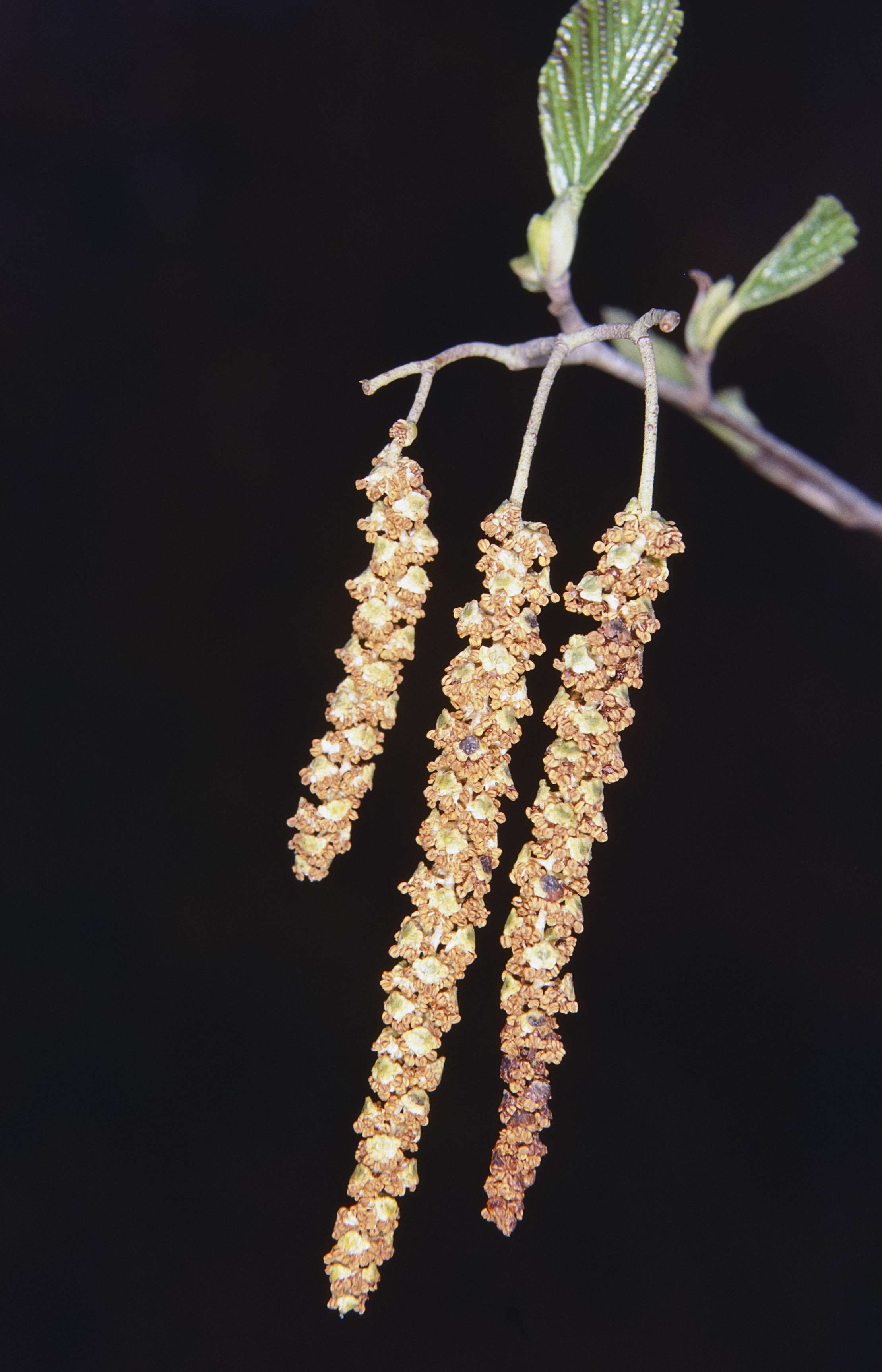
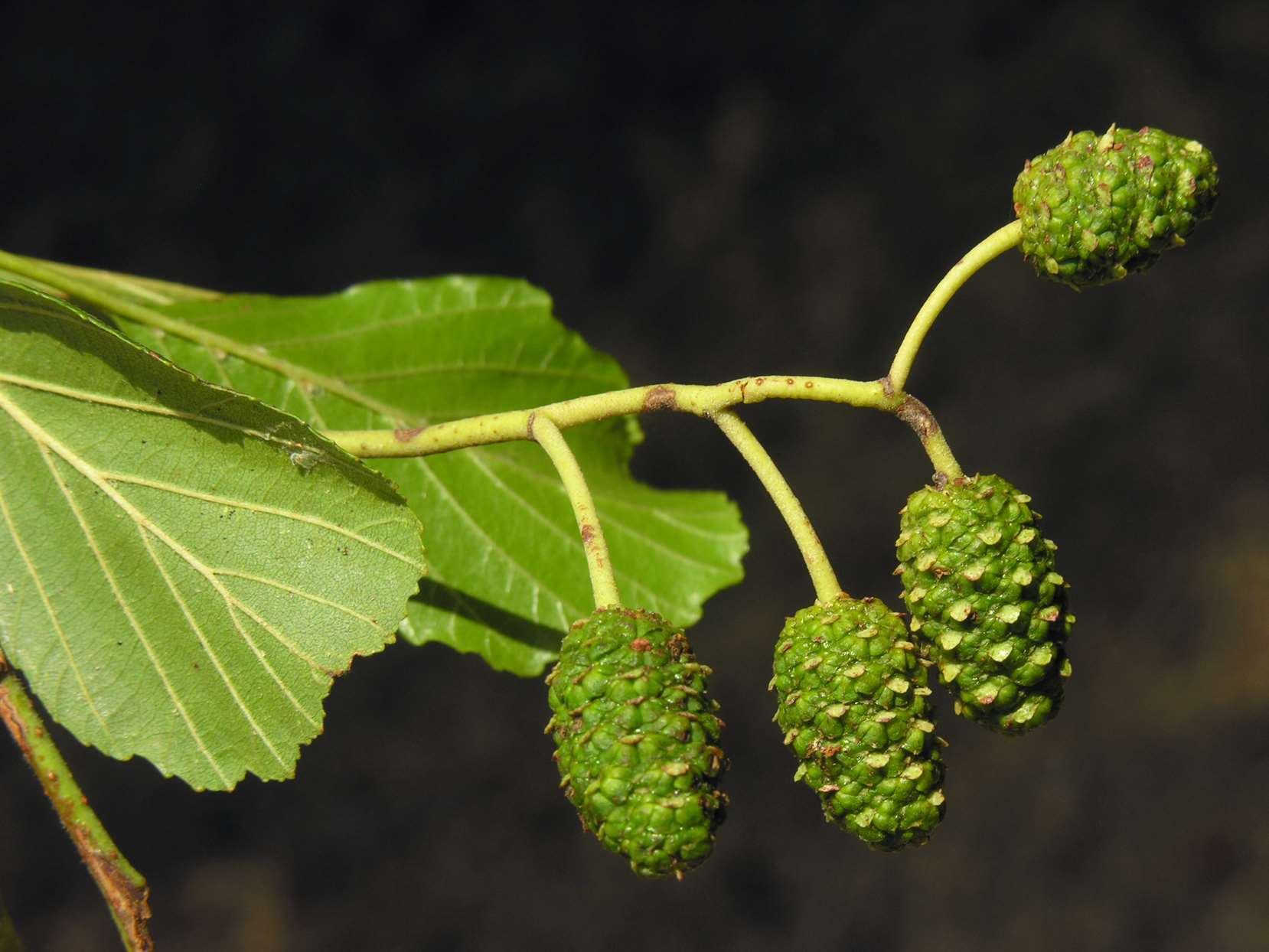
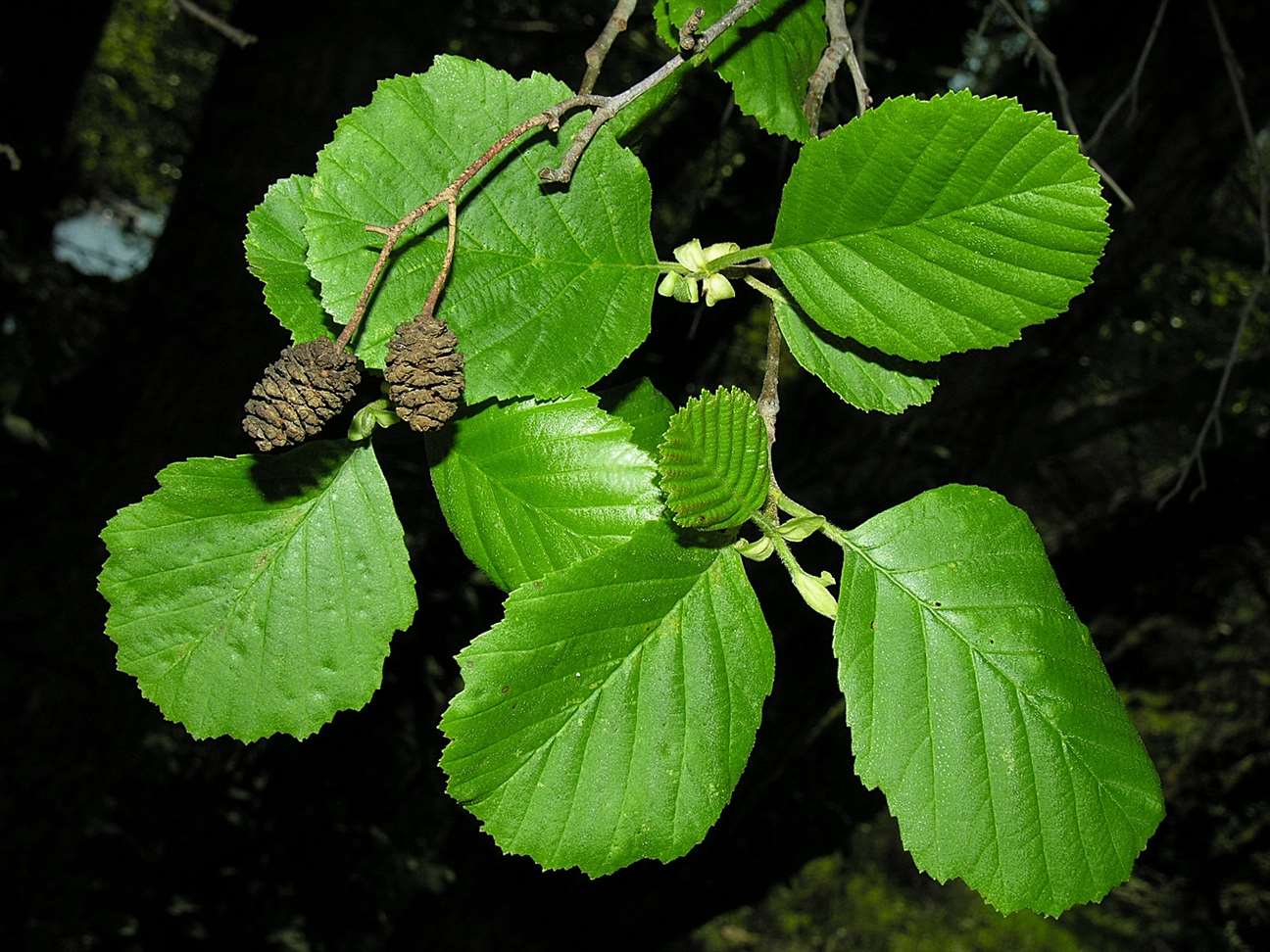
Deciduous tree, monoecious, 15-20 m in height (up to 25 m). Irregular in shape, but ± pyramidal when young, and then rounded-elongated. Trunk usually straight, up to 1 m in diameter, with smooth bark, greyish when young, turning dark brown and fissured into plates in older specimens. Branches extended. Branchlets glabrous, ± sticky. Leaves (3-12 × 2.5-11 cm) alternate, persistent, rounded, bidentate, green ± dark and glabrous on the upper side, lighter and with hairs —at least at the axil of the veins— on the underside. Petiole glabrescent (1-4 cm). Male flowers in cylindrical and pendant catkins (3-12 cm). Female flowers grouped in ovoid, pedunculate, not pendant catkins (1-2.5 × 0.7-1.2 cm); when mature they form a kind of small cone or woody strobilus of the same size, composed of scales that open to drop the seeds. Seeds very small, winged, arranged in pairs on each scale.
Flowering:
January to March.
Fruiting:
August to October.
Habitat:
Along permanent rivers and streams, on usually siliceous terrains of high humidity. In subhumid to humid bioclimate, on thermomediterranean to mesomediterranean floors. It sometimes forms beautiful forests along rivers.
Distribution:
Much of Europe, Asia and NW Africa. In the latter region, its distribution is split into 3 areas, one in Morocco (western Rif and Tingitana Peninsula), another in Algeria and Tunisia (from the Djurdjura Massif to Krumiria) and a third in the Akhdar Massif (Cyrenaica, Libya).
Observations:
A polyploid species, Alnus lusitanica Vít., Douda & Mandák, has been described from the western Iberian Peninsula. It is only slightly differentiated from A. glutinosa by the leaf apex, the length of the petiole relative to the blade, the length of the pedicels of the female catkins, and the catkins themselves, although their biometric ranges overlap. Currently, it is accepted, but only at the subspecific level, as A. glutinosa subsp. lusitanica (Vít., Douda & Mandák) Devesa. Although the first text mentions that this new taxon is present in North Africa, no material from this territory is studied, nor is the morphological diversity of A. glutinosa across its entire range examined. Therefore, further studies are needed to determine the appropriate name for the Moroccan, Algerian, and Tunisian populations.
Conservation status:
A relatively common species throughout the Palearctic, it does not seem threatened. In the IUCN Red List of Threatened Species it is listed as Least Concern (LC) at global level (Shaw et al., 2014). However, in North Africa it is a rare and much localised species. In the Livre Rouge de la flore vasculaire du Maroc (Fennane, 2021) it has been considered as Near Threatened (NT).