Anthyllis lagascana Benedí
A. sericea Lag. nom illeg., A. subsimplex auct. non Pomel
Eng.: Albaida, vetch. Spa. : Albaida sedosa, pruebayernos. Fre.: Anthyllide.
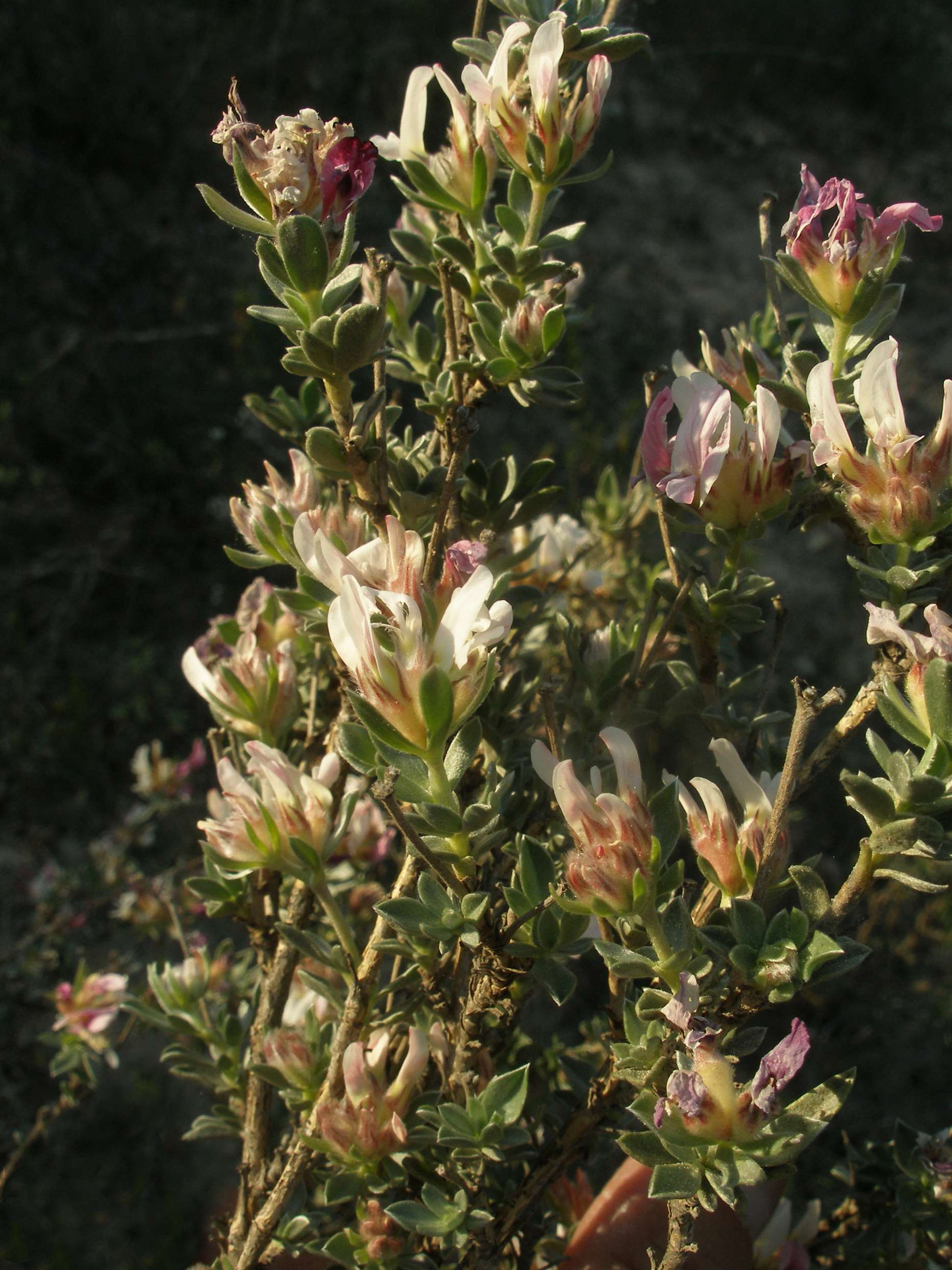
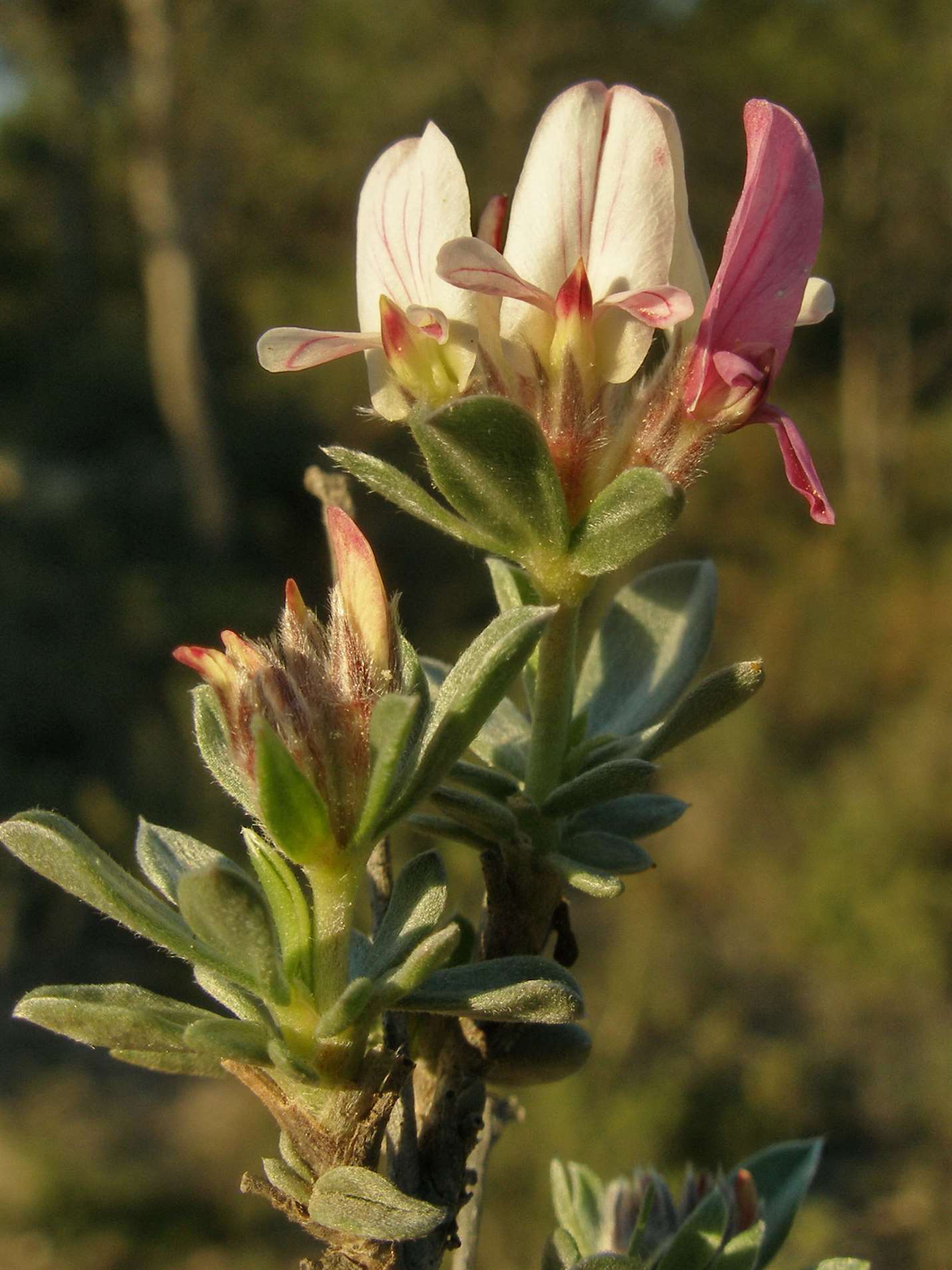
Subshrub up to 0.8(1.5) m in height, hermaphrodite, deciduous, very ramose and tangled, erect. Stems and branches with greyish-brown to whitish bark, because it is densely covered by an indumentum of very fine whitish hairs. Leaves alternate, without stipules, on a petiole that persists after the leaves fall, with 3-5 leaflets, 3.5-20 × 2-7 mm, from obovate to elliptic, entire, folded upwards by the midrib, acute, attenuated at the base, petiolulate (petiolule 0.5-3 mm), hairy and green on both sides. Inflorescence in terminal glomeruli, on hairy peduncles 10-80 mm, with 4-8 flowers. Calyx 6-8 mm, campanulate, with 5 subequal teeth, acute, purple, shorter than the tube, greenish, hairy. Corolla 6-8 mm, papilionoid, white-pinkish, with standard longer than wings and keel. Androecium submonadelphous. Ovary cylindrical, with 7-11 rudimentary seminal primordia, style arched. Pod 4-4.5 mm long, subellipsoid, apiculate, reticulate, glabrous, indehiscent, surrounded by the persistent calyx, with 1 seed. Seeds 2.5 × 2 mm, reniform, smooth or slightly punctate.
Flowering:
March to June.
Fruiting:
May to July.
Habitat:
Cleared forests, thickets and scree, usually on alkaline substrates, from near sea level up to about 1,000 m in altitude. In warm environments, from semiarid to dry.
Distribution:
Iberian-Mauritanian endemic. SE Spain, Morocco and Algeria (steppes of the central Saharan Atlas and neighbouring northern Sahara).
Conservation status:
A rare but widely distributed species, not considered threatened. Currently, it has not been assessed at a global level in the IUCN Red List of Threatened Species. In the Livre Rouge de la flore vasculaire du Maroc (Fennane, 2021) it has been considered as Critically Endangered (CR).